
PPP Models and Contract Types: The Complete Guide
May 12, 2026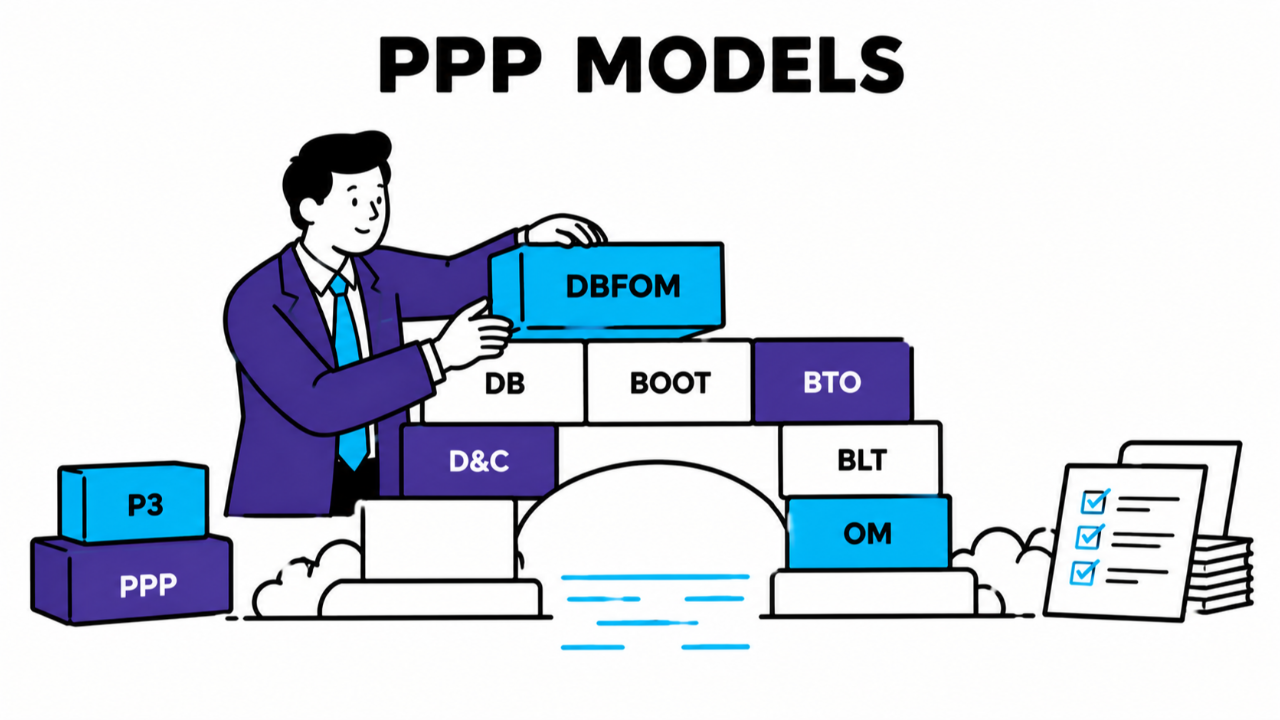
PPP Models and Contract Types: The Complete Guide
PPPs come in many shapes. A toll road concession, an availability-based hospital, a joint venture ring road and a long-term water lease are all public-private partnerships, but they allocate responsibilities, risks and revenue very differently. This guide brings together everything you need to understand PPP models and contract types: what the acronyms mean, how user-pays and government-pays PPPs differ, and how governments choose the right model for a project.
The guide follows Sections 2 and 3 of Chapter 1 of the 2026 APMG PPP Certification Guide. Start with the overview, then explore each model in detail.
Start here: the main PPP models
The PPP Guide classifies PPPs by revenue source, ownership of the project company, scope of the contract and the role of private finance. Most acronyms describe the bundle of functions transferred to the private partner.
- PPP models explained: BOT, DBFO, DBFOM and more
- PPP nomenclature around the world: PFI, P3, APP and more
From traditional procurement to private finance PPP
Contract models form a spectrum, from design-build contracts, where government keeps all long-term risk, to DBFOM contracts, where the private partner finances, builds and maintains the asset for decades.
- Design-build contracts: why they are not PPPs
- Design-build-finance (DBF) contracts: when do they make sense?
- DBOM contracts: design-build-operate-maintain without private finance
- What is DBFOM? Design-build-finance-operate-maintain explained
- What is a build-operate-transfer (BOT) contract?
Who pays: user-pays, government-pays and hybrid
The most important distinction is who pays the private partner. It decides who carries demand risk and how the project affects public finances.
- User-pays vs government-pays PPPs
- Concessions explained: the user-pays PPP
- What is an availability payment PPP?
- Hybrid PPPs: combining user fees and government payments
- Shadow tolls: how they work and when they are used
Who owns the project company
Most PPPs are delivered by a privately owned project company. In institutional PPPs, government is also a shareholder, and often the controlling one.
PPPs for existing assets and services
PPPs are not only for new infrastructure. Brownfield PPPs, leases, affermage and long-term service contracts bring private operators into existing assets, and can be used to monetise and recycle assets.
- Brownfield PPPs: leases and concessions for existing assets
- Management contracts, leases and affermage explained
Case studies
Two road projects show how flexible PPP models can be.
- The I-595 Express: a government-pays toll road, where government keeps the tolls and pays the private partner for availability.
- Madrid Calle 30: an institutional PPP, where the city council holds 80% of the project company.
Choosing the right model
There is no universally best PPP model. The right choice depends on whether users can and should pay, who can best manage demand risk, whether new investment is needed, whether private finance adds enough value to justify its cost, and what national law allows.
Where to go next
- PPP fundamentals: what a PPP is and the features that define it.
- PPP structuring and risk allocation: how to allocate risks and design payment mechanisms.
- PPPs by sector: how these models are applied in roads, energy, water, health and more.
- PPP project finance: how PPPs are financed.
All articles in this guide
- PPP Models Explained: BOT, DBFO, DBFOM and More
- What Is a Build-Operate-Transfer (BOT) Contract?
- What Is DBFOM? Design-Build-Finance-Operate-Maintain Explained
- Design-Build-Finance (DBF) Contracts: When Do They Make Sense?
- DBOM Contracts: Design-Build-Operate-Maintain Without Private Finance
- Design-Build Contracts: Why They Are Not PPPs
- User-Pays vs Government-Pays PPPs
- What Is an Availability Payment PPP?
- Concessions Explained: The User-Pays PPP
- Hybrid PPPs: Combining User Fees and Government Payments
- Shadow Tolls: How They Work and When They Are Used
- Case Study: The I-595 Express, a Government-Pays Toll Road
- Institutional PPPs: Joint Ventures Between Government and Private Partners
- Case Study: Madrid Calle 30, an Institutional PPP
- Brownfield PPPs: Leases and Concessions for Existing Assets
- Management Contracts, Leases and Affermage Explained
- PPP Nomenclature Around the World: PFI, P3, APP and More
Go further
Choosing between PPP models is one of the first decisions in any PPP project. The CP3P Foundation course explains PPP types, contract structures and payment models in line with the 2026 PPP Guide, and prepares you for the internationally recognised CP3P Foundation exam.
The PPP Alliance is an independent body of knowledge for the advancement of Public-Private Partnership knowledge and best practices. Interested in joining the community? Become a member today.
The PPP Alliance is an independent body of knowledge for the advancement of Public-Private Partnership knowledge and best practices.
Interested in joining the community? Become a member today.
Stay connected with news and updates!
Join our mailing list to receive the latest news and updates from our team.
Don't worry, your information will not be shared.
We hate SPAM. We will never sell your information, for any reason.