
PPP Models Explained: BOT, DBFO, DBFOM and More
Jun 09, 2026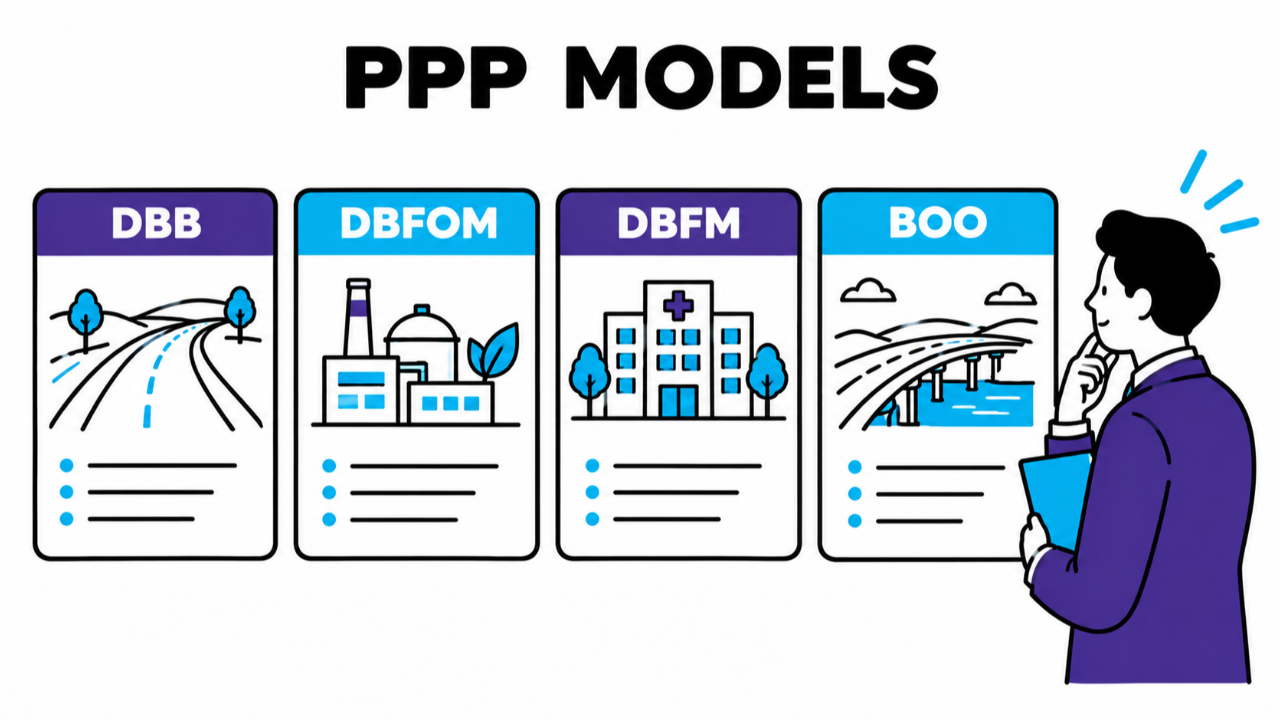
PPP Models Explained: BOT, DBFO, DBFOM and More
PPP models describe which responsibilities a government hands to the private sector and how the private partner is paid. The most common PPP models are DBFOM (Design-Build-Finance-Operate-Maintain), BOT (Build-Operate-Transfer) and their variants, concessions, availability-based PPPs and long-term service contracts. They differ in scope, ownership, financing and who carries demand risk.
This guide explains the main types of PPP, how the acronyms fit together, and how governments choose between them, following the classification in the 2026 APMG PPP Certification Guide.
Four ways to classify PPP models
The PPP Guide classifies PPPs along four dimensions. Any real project can be described by combining them.
| Dimension | Main types |
|---|---|
| Source of the private partner's revenue | User-pays PPPs (charges to users) vs government-pays PPPs (payments from the budget) |
| Ownership of the project company | Conventional PPPs (privately owned), institutional PPPs (publicly controlled), joint ventures |
| Scope of the contract | Infrastructure PPPs (significant capital investment), integrated PPPs (infrastructure plus a public service), O&M or service PPPs (no major new investment) |
| Role of private finance | Conventional PPPs vs co-financed or hybrid PPPs with significant public money |
Investors also distinguish greenfield projects (new assets), brownfield projects (assets already in operation) and yellowfield or secondary-stage projects (major renewals, refurbishment or expansion of existing assets).
Models defined by scope: the acronyms
Most PPP acronyms describe the bundle of functions the private partner takes on.
DBFOM and its variants
DBFOM, Design-Build-Finance-Operate-Maintain, is the typical private finance PPP. The private partner designs and builds the asset, raises the finance, and operates and maintains it for the life of the contract. Variants include:
- DBFM: no operations in the strict sense, for example a hospital building where clinical services stay public;
- DBFO: maintenance is treated as part of operations;
- DCMF: Design-Construct-Maintain-Finance, a term used in some countries.
The PPP Guide treats all of these as synonyms for a private finance PPP.
BOT and ownership-based terms
Build-Operate-Transfer (BOT) and related terms describe the same bundle of functions but also say who owns the asset:
- BOT: the private partner builds and operates the asset, then transfers it to government;
- BOOT: Build-Own-Operate-Transfer, with private ownership during the contract;
- BTO: Build-Transfer-Operate, with ownership transferring to government after construction;
- ROT: Rehabilitate-Operate-Transfer, for upgrades of existing assets;
- BOO / ROO: Build-Own-Operate (or Rehabilitate-Own-Operate), where the private partner owns the facility and sells its output.
The Guide regards these as part of the DBFOM family. It notes that ownership terms can confuse, because legal, economic and tax ownership differ, and in many civil law countries the private partner cannot legally own public assets at all.
Models that fall short of a private finance PPP
- DBOM (Design-Build-Operate-Maintain): bundles construction and long-term maintenance, but government finances construction. A PPP in the broad sense, not a private finance PPP.
- DBF (Design-Build-Finance): the contractor pre-finances construction against deferred fixed payments. Not regarded as a PPP by the Guide.
- DB (design-build) and build-only: traditional procurement.
Models defined by revenue
The most important classification is where the private partner's money comes from.
- User-pays PPPs, commonly called concessions: the private partner collects tolls, tariffs or fares and carries demand risk. Typical in roads, airports, ports and some water projects.
- Government-pays PPPs, often called availability PPPs or PFI: government pays for the asset being available and performing. Typical for hospitals, schools, non-tolled roads and prisons.
- Hybrid PPPs: a mix, where user revenue is topped up with grants or performance-based government payments.
Models for existing assets and services
Not every PPP builds something new. For existing infrastructure and public services, common models include:
- Concessions of services and leases, where the private partner operates an existing asset and collects user revenue;
- Affermage, a French model in which the operator keeps a fee from user receipts and passes the rest to the authority;
- Long-term management, O&M and service contracts, which count as PPPs only if they are long-term, transfer significant risk and are performance-based.
These are explored in management contracts, leases and affermage.
Choosing the right PPP model
The right model depends on the project and the government's objectives:
- Can users pay? If user revenue can cover most costs, a concession may work. If not, a government-pays or hybrid model is needed.
- Who should carry demand risk? Transfer it only when the private partner can influence or reasonably forecast demand.
- Is new investment required? New or heavily upgraded assets call for DBFOM-type models; well-functioning existing assets may only need a management or lease contract.
- Is private finance worth its cost? If budget funds are available and lender discipline adds little, a DBOM may deliver similar benefits more cheaply.
- What is legally possible? National law may restrict ownership, define PPP narrowly, or require specific contract forms.
The chosen model then shapes the tender process, the risk allocation and the payment mechanism.
This article is part of our PPP Models and Contract Types: The Complete Guide.
Key takeaways
- PPP models can be classified by revenue source, ownership, scope and the role of private finance.
- DBFOM and its variants are the typical private finance PPP; BOT-type terms add information about ownership.
- DBOM is a PPP in the broad sense; DBF and DB are not PPPs under the PPP Guide.
- User-pays (concession), government-pays (availability) and hybrid models differ mainly in who carries demand risk.
- The best model depends on users' ability to pay, the need for new investment, the value of private finance and national law.
Go further
Choosing between PPP models is one of the first decisions in any PPP project. The CP3P Foundation course explains PPP types, contract structures and payment models in line with the 2026 PPP Guide, and prepares you for the internationally recognised CP3P Foundation exam.
Related reading
- PPP Models and Contract Types: The Complete Guide
- What Is DBFOM? Design-Build-Finance-Operate-Maintain Explained
- What Is a Build-Operate-Transfer (BOT) Contract?
- Design-Build Contracts: Why They Are Not PPPs
- Management Contracts, Leases and Affermage Explained
- Main Types of PPP Tender Processes
- Road and Highway PPPs: Models and Lessons Learned
The PPP Alliance is an independent body of knowledge for the advancement of Public-Private Partnership knowledge and best practices. Interested in joining the community? Become a member today.
The PPP Alliance is an independent body of knowledge for the advancement of Public-Private Partnership knowledge and best practices.
Interested in joining the community? Become a member today.
Stay connected with news and updates!
Join our mailing list to receive the latest news and updates from our team.
Don't worry, your information will not be shared.
We hate SPAM. We will never sell your information, for any reason.