
What Is an Availability Payment PPP?
Jun 30, 2026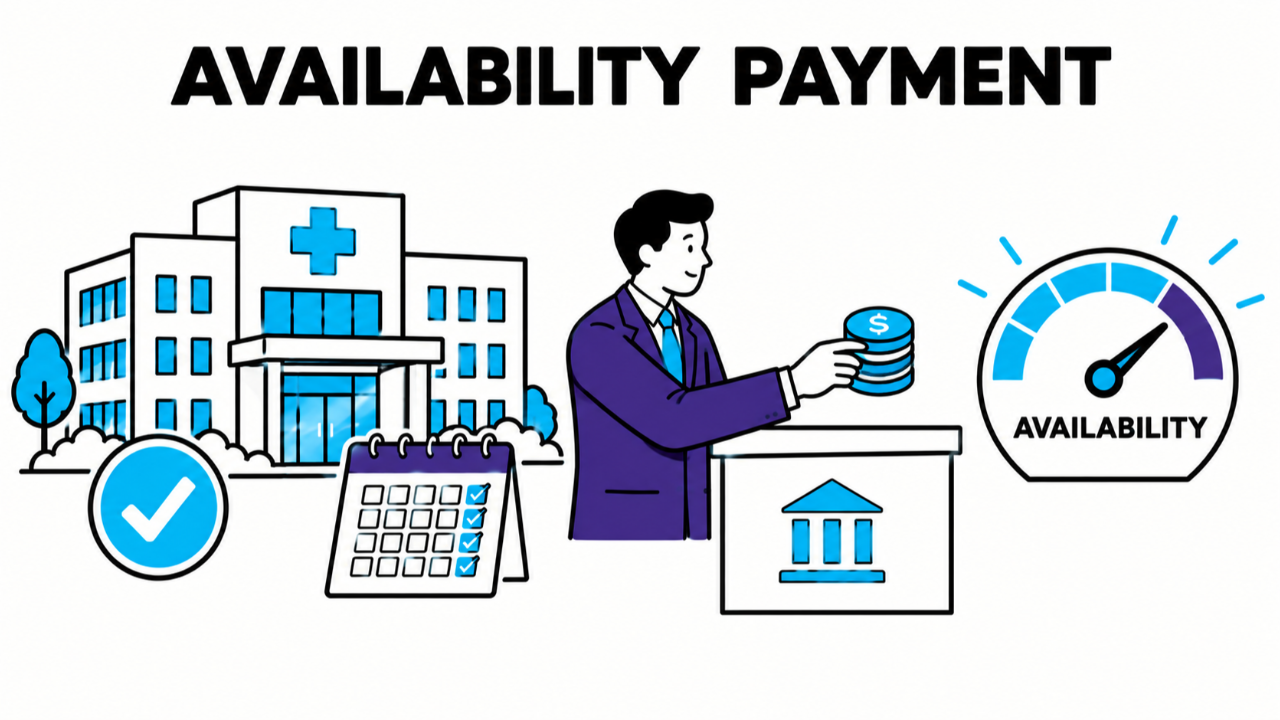
What Is an Availability Payment PPP?
An availability payment is a regular payment that government makes to a PPP private partner for keeping an asset available for use and performing to agreed standards. In an availability payment PPP, the private partner designs, builds, finances, operates and maintains the asset, and is paid by government rather than by users. If parts of the asset are unavailable or fall below standard, the payment is reduced.
This article explains how availability payment PPPs work, how payments and deductions are designed, and the advantages and risks of the model.
What is an availability payment PPP?
An availability payment PPP is a government-pays DBFOM contract. The 2026 APMG PPP Certification Guide describes the private partner's revenue in these contracts as resulting from service provision to the grantor: making infrastructure available, after first designing and building it, with an ongoing obligation to maintain and usually operate it. The private partner is paid for both construction and O&M only as long as, and to the extent that, the infrastructure is available under specified availability and quality standards.
In the UK, this model was known as the Private Finance Initiative (PFI). Several Latin American countries reserve the legal term PPP (or APP) for this type of contract.
When availability payments are used
Governments use availability payments when:
- there are no users to charge, for example prisons, courts and government offices;
- users should not be charged, for example public hospitals, schools and non-tolled roads;
- user revenue would be too small compared with capital costs, as in most rail projects;
- government wants to control tariffs or tolling strategy itself.
How the payment works
The payment is typically a single periodic amount, often called the unitary charge or unitary payment, paid monthly or quarterly once the asset is in service. It is sized in the winning bid to cover:
- construction costs, through repayment of debt and return on equity;
- operating and maintenance costs;
- life-cycle costs for major maintenance and renewals.
The payment is usually partly indexed to inflation to reflect operating costs.
Deductions: making availability mean something
The payment is reduced when the asset does not meet the contract's requirements. Typical deductions apply for:
- Unavailability: a hospital ward, school classroom or road lane that cannot be used safely as specified;
- Performance failures: service standards not met, such as late repairs, poor cleaning or failed response times;
- Reporting failures: inaccurate or late performance reports.
Deductions are usually weighted by the importance of the area or service. An operating theatre being unavailable costs more than a storage room. Rectification periods give the private partner time to fix problems before a deduction applies. Persistent failures can lead to warning notices and, eventually, termination.
The design of these regimes is covered in more detail in performance deductions and the broader PPP payment mechanism.
Who carries which risks?
| Risk | Availability PPP |
|---|---|
| Construction cost and delay | Private partner |
| Availability and performance | Private partner |
| Life-cycle and maintenance cost | Private partner |
| Demand / usage | Usually government |
| Inflation | Shared, through partial indexation |
| Change in policy or requirements | Usually government |
Because the private partner does not carry demand risk, availability PPPs are generally easier to finance than user-pays concessions, and financing costs can be lower.
Advantages
- Infrastructure without user charges. Government can deliver free-at-the-point-of-use services.
- Strong performance incentives. Payment depends on availability and quality for the life of the contract.
- Lower risk premium. Without demand risk, lenders and investors require lower returns.
- Government keeps control of pricing, tolling and demand management.
Risks and challenges
- Long-term fiscal commitment. Government commits to payments for 20 to 30 years. Even if the project is not recorded as public debt, the Guide stresses that these commitments affect the long-term fiscal position. Affordability must be tested before procurement.
- Monitoring burden. Government must measure availability and performance accurately and apply deductions consistently, which requires a capable contract management team.
- Weak deductions. If deductions are too small, or never applied, the performance incentive disappears.
- Inflexibility. Changing requirements over a long contract can be expensive.
Variations
- With capital grants: government pays part of construction cost as grants to reduce later availability payments.
- With tolls retained by government: users pay tolls, but the authority keeps the revenue and pays the private partner availability payments. The I-595 Express in Florida is a well-known example.
- With volume-based elements: some government-pays PPPs pay per user rather than for availability, such as shadow tolls.
For a broader comparison with concessions, see user-pays vs government-pays PPPs.
This article is part of our PPP Models and Contract Types: The Complete Guide.
Key takeaways
- An availability payment is a government payment for keeping a PPP asset available and performing to standard.
- Availability PPPs are government-pays DBFOMs, known in the UK as PFI.
- Payments are reduced through deductions for unavailability and poor performance.
- Demand risk usually stays with government, making these projects easier to finance.
- Governments must manage long-term affordability and monitor performance carefully.
Go further
Choosing between PPP models is one of the first decisions in any PPP project. The CP3P Foundation course explains PPP types, contract structures and payment models in line with the 2026 PPP Guide, and prepares you for the internationally recognised CP3P Foundation exam.
Related reading
- PPP Models and Contract Types: The Complete Guide
- User-Pays vs Government-Pays PPPs
- Case Study: The I-595 Express, a Government-Pays Toll Road
- Shadow Tolls: How They Work and When They Are Used
- Design-Build-Finance (DBF) Contracts: When Do They Make Sense?
- Payment Mechanisms in PPPs Explained
- Deductions and Performance Regimes in Availability PPPs
The PPP Alliance is an independent body of knowledge for the advancement of Public-Private Partnership knowledge and best practices. Interested in joining the community? Become a member today.
The PPP Alliance is an independent body of knowledge for the advancement of Public-Private Partnership knowledge and best practices.
Interested in joining the community? Become a member today.
Stay connected with news and updates!
Join our mailing list to receive the latest news and updates from our team.
Don't worry, your information will not be shared.
We hate SPAM. We will never sell your information, for any reason.