
DBOM Contracts: Design-Build-Operate-Maintain Without Private Finance
Oct 01, 2026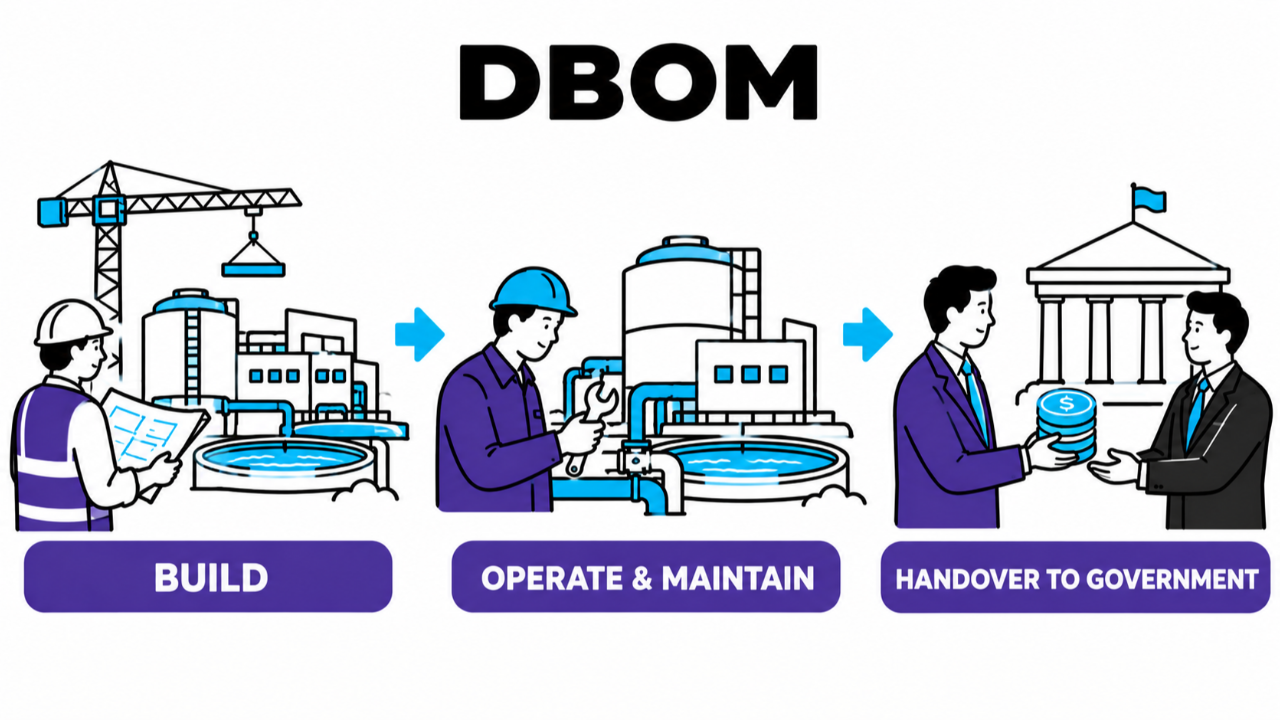
DBOM Contracts: Design-Build-Operate-Maintain Without Private Finance
A DBOM contract, short for Design-Build-Operate-Maintain, bundles the design and construction of an asset with its long-term operation and maintenance, but without private finance. Government pays for construction as it progresses, from its own budget, and then pays the contractor a separate price for operation and maintenance over the contract term. DBOM sits between traditional procurement and a full private finance PPP.
This article explains how DBOM contracts work, how they compare with DBFOM, and when governments choose them.
How a DBOM contract works
Under a DBOM:
- The contractor designs and builds the asset, and government pays for the works as they progress, as in a conventional design-build contract.
- The contractor then operates and maintains the asset for a number of years at a pre-agreed price, paid by government in a separate stream.
- The O&M price is closely tied to performance, often through penalties or liquidated damages for failures.
If the contractor does not operate the asset, the contract is called a DBM (Design-Build-Maintain). Depending on the jurisdiction, the authority may take over the asset at completion of construction or at the end of the contract.
Is DBOM a PPP?
The 2026 APMG PPP Certification Guide treats DBOM as an infrastructure PPP in the broad sense, but not as a private finance PPP. Many countries classify DBOM as a type of PPP because, when maintenance risk is genuinely transferred alongside construction risk, it comes close to the PPP concept in scope and potential efficiency.
What DBOM lacks is private capital at risk. The contractor's own money is not tied up in the asset for the long term, so the incentive to build for the whole life cycle is weaker than in a DBFOM.
DBOM vs DBFOM
| DBOM | DBFOM | |
|---|---|---|
| Construction finance | Government, paid as work progresses | Private partner, repaid over the contract life |
| Payment for construction | During construction | Mostly after the asset is in service |
| Long-term maintenance | Contractor, paid a separate O&M price | Private partner, paid through a single performance-based payment |
| Life-cycle risk transfer | Limited, often through liquidated damages | Significant |
| Lender oversight | None | Throughout the contract |
| Regarded as a private finance PPP | No | Yes |
Strengths of the DBOM model
- Integrated design, construction and maintenance. One contractor is responsible for both building and maintaining the asset, which encourages more durable design.
- Lower financing cost. Construction is funded by government borrowing or budget, which is usually cheaper than private finance.
- Simpler to procure. Without project finance, there are fewer parties, documents and lender requirements.
- Faster to close. There is no financial close process.
Weaknesses of the DBOM model
The Guide highlights several limitations:
- Incentives to cut construction costs remain. Because construction is paid as it progresses, the contractor may still reduce quality to increase its margin. Government must control this carefully.
- Maintenance risk largely stays with government. The risk of unexpected maintenance costs can be transferred only in a limited way, usually through liquidated damages. The main portion of maintenance risk, which depends on how well the asset was designed and built, generally remains public.
- Loss of competition for O&M. By bundling O&M with construction, government gives up the chance to run a separate competition for the operating contract later. It chooses DBOM when it expects the benefits of integration to outweigh this loss.
- No lender discipline. There is no independent financier scrutinising the project.
When governments choose DBOM
Governments tend to use DBOM when the project and financial context do not justify a full private finance PPP. Typical situations include:
- budget funds are available, so private finance would add cost without enough extra benefit;
- the project is too small for the transaction costs of project finance;
- financial markets are not deep enough to provide long-term project finance;
- government wants the integration benefits of whole-life maintenance without the complexity of a PPP.
DBOM is common for water and wastewater treatment plants, waste facilities and some transport projects.
Making a DBOM work
- Specify outputs, not inputs, for both construction and O&M.
- Make the O&M period long enough to cover major maintenance cycles.
- Link payments to performance with meaningful deductions.
- Retain part of the construction payment, or require security, until the asset has proven its performance.
- Plan for handback, with clear asset condition requirements.
This article is part of our PPP Models and Contract Types: The Complete Guide.
Key takeaways
- DBOM bundles design, construction, operation and maintenance, but government finances construction.
- The PPP Guide regards DBOM as a PPP in the broad sense, not a private finance PPP.
- It is cheaper and simpler than DBFOM, but transfers less life-cycle risk and lacks lender discipline.
- Contractors may still be tempted to cut construction quality, so oversight remains important.
- DBOM suits projects where integration helps but private finance would not add enough value.
Go further
Choosing between PPP models is one of the first decisions in any PPP project. The CP3P Foundation course explains PPP types, contract structures and payment models in line with the 2026 PPP Guide, and prepares you for the internationally recognised CP3P Foundation exam.
Related reading
- PPP Models and Contract Types: The Complete Guide
- What Is DBFOM? Design-Build-Finance-Operate-Maintain Explained
- Design-Build Contracts: Why They Are Not PPPs
- Design-Build-Finance (DBF) Contracts: When Do They Make Sense?
- What Is a Build-Operate-Transfer (BOT) Contract?
- What Is a Private Finance PPP?
- Whole-Life Maintenance: Why PPP Assets Last Longer
The PPP Alliance is an independent body of knowledge for the advancement of Public-Private Partnership knowledge and best practices. Interested in joining the community? Become a member today.
The PPP Alliance is an independent body of knowledge for the advancement of Public-Private Partnership knowledge and best practices.
Interested in joining the community? Become a member today.
Stay connected with news and updates!
Join our mailing list to receive the latest news and updates from our team.
Don't worry, your information will not be shared.
We hate SPAM. We will never sell your information, for any reason.