
User-Pays vs Government-Pays PPPs
Apr 27, 2026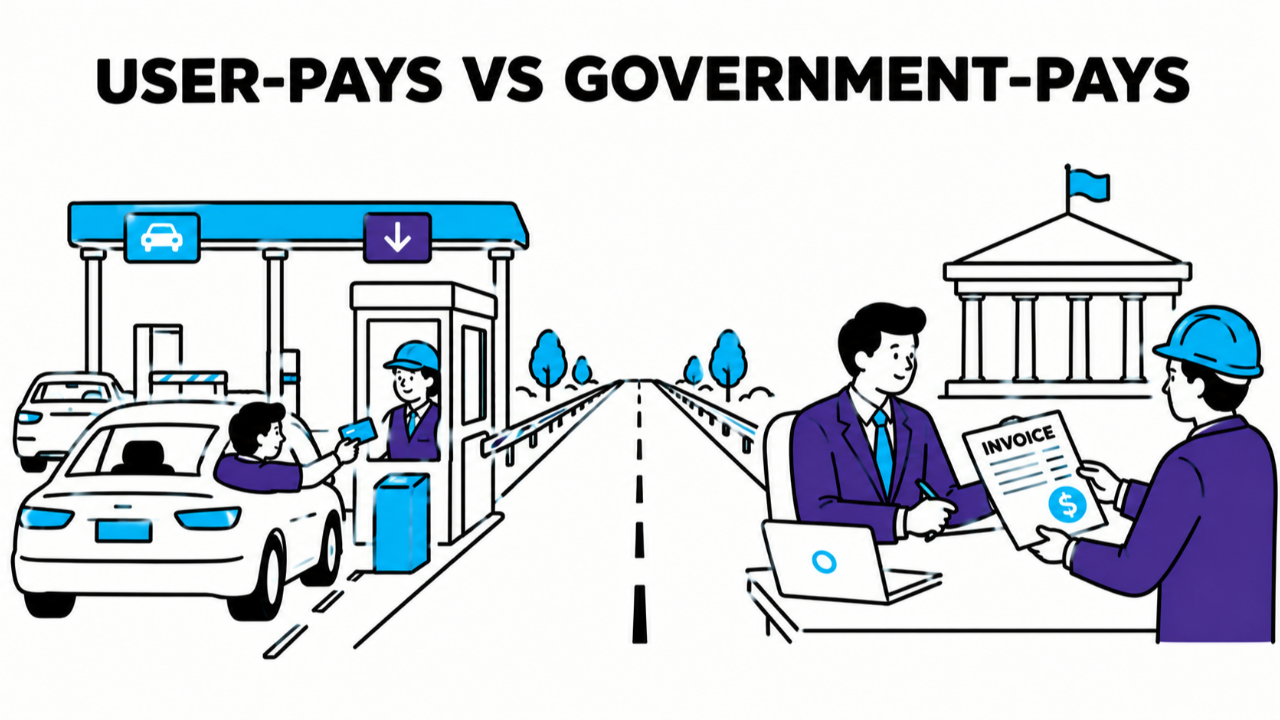
User-Pays vs Government-Pays PPPs
The most important way to classify a PPP is by who pays the private partner. In a user-pays PPP, the private partner collects charges directly from users, such as tolls, tariffs or fares. In a government-pays PPP, the procuring authority pays the private partner from its budget, typically through availability payments. The choice determines who carries demand risk, how the project is financed, and what it means for public finances.
This article compares user-pays and government-pays PPPs and explains how governments choose between them.
User-pays PPPs (concessions)
In a user-pays PPP, government grants the private partner the right to charge users for the use of the asset or service. The 2026 APMG PPP Certification Guide describes this as a contractual assignment of future revenues associated with the public use of infrastructure, as a means to fund its development and related services. These contracts are widely known as concessions, especially in civil law countries.
The private partner uses user revenue to cover operating and maintenance costs, repay its lenders and provide a return to investors. It remains the economic owner of the asset during the contract and must maintain and renew it at its own expense. If revenues exceed what is needed for a reasonable return, the contract may require some revenue sharing with the authority.
Typical sectors: toll roads, airports, ports, and some water and telecom projects, where user revenues are significant.
Government-pays PPPs (availability-based or PFI)
In a government-pays PPP, the private partner earns its revenue by providing a service to the authority: making the infrastructure available to agreed standards. Payments are made only when, and to the extent that, the asset is available and performing. These are often called availability payment PPPs, or PFI in the United Kingdom.
Governments choose this model when:
- there are no users who can be charged, for example a prison or court;
- user revenue would be insignificant compared with the capital cost, as in most rail projects;
- government wants the infrastructure to be free at the point of use, for example a non-tolled road, school or hospital.
Side-by-side comparison
| User-pays PPP | Government-pays PPP | |
|---|---|---|
| Common names | Concession | Availability PPP, PFI, APP (some Latin American countries) |
| Who pays the private partner | Users | Procuring authority |
| Funding source | User charges | Taxes / public budget |
| Demand risk | Usually private partner | Usually government |
| What the private partner is paid for | Use of the asset | Availability and service quality |
| Fiscal impact | Lower direct budget commitment, but possible guarantees | Long-term payment commitment |
| Typical sectors | Roads, airports, ports, some water | Hospitals, schools, prisons, rail, non-tolled roads |
| Key risk to manage | Demand forecasting and tariff policy | Affordability and performance monitoring |
Demand risk: the decisive difference
The biggest practical difference is demand risk. In a user-pays PPP, if fewer people use the asset than forecast, the private partner's revenue falls. This makes forecasting critical and can make projects harder to finance. In a government-pays PPP, the private partner is paid for availability regardless of usage, so government keeps the demand risk.
Demand risk should sit with the party best able to manage it. A private operator can influence demand at an airport through marketing and service; it has much less influence over traffic on a road network that government plans. Our article on demand risk explores this further.
Fiscal implications
User-pays PPPs can reduce or eliminate direct budget payments, but they are not free for government. Tariff decisions are politically sensitive, and governments often provide guarantees, subsidies or compensation commitments that create contingent liabilities.
Government-pays PPPs create explicit long-term payment commitments. Even if they are not recorded as public debt, they affect the government's long-term fiscal position, which is why many countries cap total PPP commitments.
Hybrids and variations
Many projects fall between the two models:
- Co-financed concessions, where government provides capital grants to close a viability gap;
- Hybrid PPPs that combine user charges with availability or service payments, standard in rail;
- Government-pays PPPs with tolls retained by government, as in the I-595 Express in Florida, where the authority collects tolls but pays the private partner availability payments;
- Government-pays PPPs with some commercial revenue, which still count as government-pays as long as government payments are the majority of revenue.
Terminology varies by country
Several countries, especially in Latin America, reserve the term PPP for government-pays contracts and call user-pays projects concessions. The UK uses PFI for government-pays PPPs. Some civil law countries such as Chile and Spain use "concession" for both. Always check how local law defines each term.
How the payment model shapes the contract
The revenue model drives the design of the PPP payment mechanism: tariff setting and indexation in user-pays PPPs, and availability standards, KPIs and deductions in government-pays PPPs.
This article is part of our PPP Models and Contract Types: The Complete Guide.
Key takeaways
- User-pays PPPs (concessions) are funded by charges to users; government-pays PPPs by payments from the budget.
- The key difference is demand risk: usually private in user-pays, public in government-pays.
- User-pays suits assets with strong user revenue; government-pays suits social infrastructure and assets that are free at the point of use.
- Both create fiscal exposure, either through payment commitments or through guarantees and contingent liabilities.
- Hybrid models are common, and terminology varies widely between countries.
Go further
Choosing between PPP models is one of the first decisions in any PPP project. The CP3P Foundation course explains PPP types, contract structures and payment models in line with the 2026 PPP Guide, and prepares you for the internationally recognised CP3P Foundation exam.
Related reading
- PPP Models and Contract Types: The Complete Guide
- Concessions Explained: The User-Pays PPP
- What Is an Availability Payment PPP?
- Case Study: The I-595 Express, a Government-Pays Toll Road
- Hybrid PPPs: Combining User Fees and Government Payments
- Payment Mechanisms in PPPs Explained
- Demand Risk: Who Should Carry It?
The PPP Alliance is an independent body of knowledge for the advancement of Public-Private Partnership knowledge and best practices. Interested in joining the community? Become a member today.
The PPP Alliance is an independent body of knowledge for the advancement of Public-Private Partnership knowledge and best practices.
Interested in joining the community? Become a member today.
Stay connected with news and updates!
Join our mailing list to receive the latest news and updates from our team.
Don't worry, your information will not be shared.
We hate SPAM. We will never sell your information, for any reason.