
What Is a Build-Operate-Transfer (BOT) Contract?
Jan 20, 2026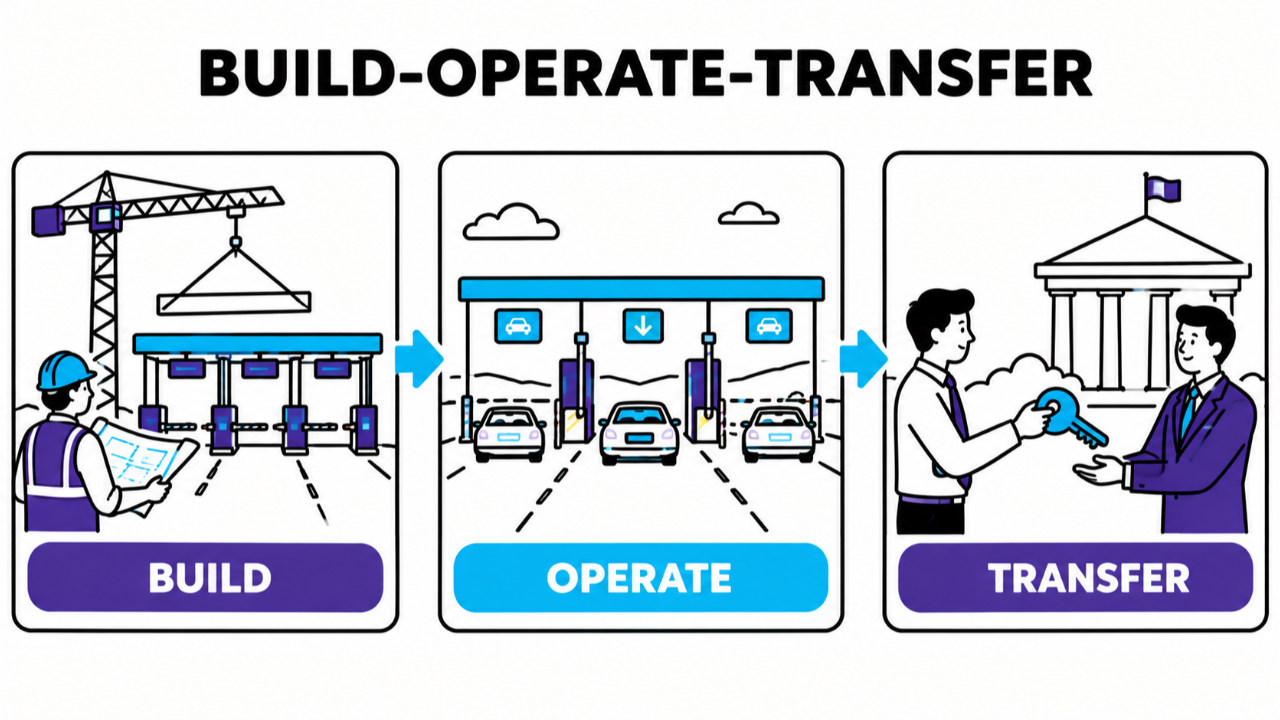
What Is a Build-Operate-Transfer (BOT) Contract?
A Build-Operate-Transfer (BOT) contract is a PPP model in which a private partner builds an infrastructure asset, operates it for a fixed period, typically 20 to 30 years, and then transfers it to government. During the contract, the private partner recovers its investment from user charges or government payments. BOT is one of the oldest and most widely recognised PPP models, especially in transport, power and water.
This article explains how a BOT contract works, its variants, how it compares with DBFOM, and its strengths and risks.
How a BOT contract works
A BOT project typically follows three phases:
- Build. The private partner, usually a special purpose vehicle (SPV), designs, finances and constructs the asset. It carries the risk of cost overruns and delays, and typically earns no revenue until the asset is operating.
- Operate. For the contract period, the SPV operates and maintains the asset to the standards in the contract. It earns revenue from users (for example, tolls) or from a public offtaker (for example, payments under a Power Purchase Agreement), and uses it to cover costs, repay lenders and pay investors.
- Transfer. At the end of the contract, the asset is handed back to government, usually free of charge and in a specified condition.
The BOT family of models
Several related acronyms describe variations on ownership and timing.
| Model | Meaning | Ownership |
|---|---|---|
| BOT | Build-Operate-Transfer | Asset transferred to government at the end of the contract |
| BOOT | Build-Own-Operate-Transfer | Private partner owns the asset during the contract, then transfers it |
| BTO | Build-Transfer-Operate | Ownership passes to government after construction; private partner then operates |
| ROT | Rehabilitate-Operate-Transfer | Like BOT, but for rehabilitating or upgrading an existing asset |
| BOO | Build-Own-Operate | Private partner builds, owns and operates the facility and sells its output |
| ROO | Rehabilitate-Own-Operate | Like BOO, for an existing asset that the private partner rehabilitates |
BOT vs DBFOM: same model, different emphasis
The 2026 APMG PPP Certification Guide treats BOT and its variants as synonyms for the DBFOM family. The scope is the same: design, build, finance, operate and maintain. The difference is in what the acronym emphasises:
- DBFOM lists the functions transferred to the private partner and says nothing about ownership.
- BOT-type terms describe who legally owns and controls the asset and when it is transferred.
The Guide cautions that ownership-based acronyms can create confusion. Ownership has several dimensions (legal, economic and tax), and in many civil law countries the private partner cannot legally own public infrastructure; it may be the owner only in economic terms, while legal title remains public. In those countries, BOT labels are not very informative. What matters for a PPP is that the asset is public, or will become public at the end of the contract.
Read more in our overview of PPP models.
Where BOT is used
BOT and its variants are common in:
- Toll roads, bridges and tunnels, where user charges repay the investment;
- Power generation, where independent power producers build plants and sell electricity to a state utility under a long-term Power Purchase Agreement;
- Water and wastewater treatment plants, often paid through a bulk water purchase agreement;
- Ports and airports, where terminals are developed and operated under concessions.
BOO is particularly common for power plants, where the facility may remain in private ownership after the offtake contract ends.
Why governments use BOT
- Private finance and delivery capacity. The private partner raises the money and manages construction.
- Risk transfer. Construction, operating and, in user-pays BOTs, demand risks can be transferred to the private partner. This is the core of PPP risk transfer.
- Life-cycle incentives. Because the same partner builds and operates the asset, it has a reason to build well.
- Return of the asset. Government gets the asset back at the end of the contract.
Risks and pitfalls
- Demand risk. In user-pays BOTs, optimistic traffic or demand forecasts can lead to financial distress and renegotiation.
- Handback condition. Without clear requirements and monitoring, assets may be run down in the final years before transfer.
- Offtaker risk. In power and water BOTs, the private partner depends on the creditworthiness of the public offtaker, and government may need to provide guarantees.
- Rigidity. Long contracts can be costly to change if needs evolve.
- Contingent liabilities. Guarantees and termination payments can create hidden fiscal exposure.
What makes a BOT a true PPP?
A BOT label alone does not guarantee a PPP. It meets the essential features of a PPP contract only if the private partner has significant capital at risk, carries meaningful construction and operating risk, and is paid according to performance or use. A BOT in which government guarantees all revenues and debt, regardless of performance, is a financing arrangement in disguise.
This article is part of our PPP Models and Contract Types: The Complete Guide.
Key takeaways
- A BOT contract has the private partner build, operate and then transfer an asset to government.
- BOOT, BTO, ROT, BOO and ROO are variants that differ in ownership and in whether the asset is new or rehabilitated.
- The PPP Guide treats BOT-type terms as synonyms for DBFOM; they add information about ownership, not scope.
- BOT is common in toll roads, power, water, ports and airports.
- It is a true PPP only when private capital is at risk and pay depends on performance or use.
Go further
Choosing between PPP models is one of the first decisions in any PPP project. The CP3P Foundation course explains PPP types, contract structures and payment models in line with the 2026 PPP Guide, and prepares you for the internationally recognised CP3P Foundation exam.
Related reading
- PPP Models and Contract Types: The Complete Guide
- PPP Models Explained: BOT, DBFO, DBFOM and More
- What Is DBFOM? Design-Build-Finance-Operate-Maintain Explained
- DBOM Contracts: Design-Build-Operate-Maintain Without Private Finance
- Design-Build Contracts: Why They Are Not PPPs
- Risk Transfer: The Engine of PPP Value
- The Essential Features of a PPP Contract
The PPP Alliance is an independent body of knowledge for the advancement of Public-Private Partnership knowledge and best practices. Interested in joining the community? Become a member today.
The PPP Alliance is an independent body of knowledge for the advancement of Public-Private Partnership knowledge and best practices.
Interested in joining the community? Become a member today.
Stay connected with news and updates!
Join our mailing list to receive the latest news and updates from our team.
Don't worry, your information will not be shared.
We hate SPAM. We will never sell your information, for any reason.