
What Is DBFOM? Design-Build-Finance-Operate-Maintain Explained
May 15, 2026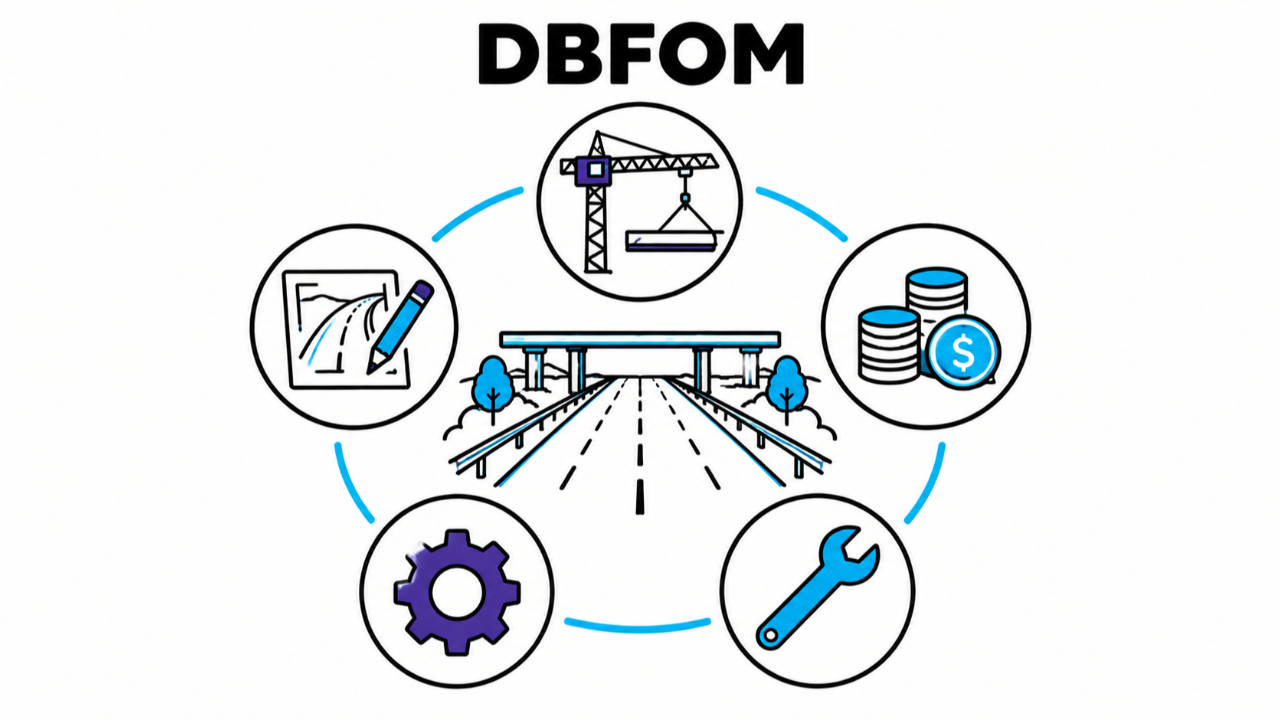
What Is DBFOM? Design-Build-Finance-Operate-Maintain Explained
DBFOM stands for Design-Build-Finance-Operate-Maintain. It is the typical form of a private finance PPP: one private partner designs and builds an infrastructure asset, raises the money to pay for it, and then operates and maintains it for a long period, usually 20 to 30 years. It is paid by users, by government or both, according to the asset's performance or use.
This article explains how a DBFOM contract works, its structure and variants, and what it takes for a DBFOM to deliver the benefits of a PPP.
What each letter means
- Design: the private partner develops the design to meet the government's output specifications.
- Build: it constructs the asset, carrying the risk of cost overruns and delays.
- Finance: it raises all or most of the money for construction, usually through equity and project finance debt, at its own risk.
- Operate: it runs the asset or service, for example collecting tolls or managing a facility.
- Maintain: it carries out routine and major maintenance and renewals for the life of the contract.
The 2026 APMG PPP Certification Guide describes DBFOM (and DBFM, where there are no operations in the strict sense) as the only contract scope that meets all the conditions of a private finance PPP. Related names such as DBFO, DCMF and the BOT family are treated as synonyms.
How a DBFOM is structured
A DBFOM usually involves:
- the procuring authority, which signs the PPP contract;
- a project company (SPV) created by the winning consortium;
- equity investors, who own the SPV;
- lenders, who provide most of the finance under a loan agreement;
- an EPC contractor, which carries out design and construction under a construction contract;
- an O&M contractor, which operates and maintains the asset under an O&M contract.
The SPV passes most construction and operating risks down to its subcontractors. Its revenues come either from users (in a user-pays DBFOM) or from government payments based on availability or volume (in a government-pays DBFOM). At the end of the contract, the asset is handed back to the authority.
User-pays and government-pays DBFOM
| User-pays DBFOM (concession) | Government-pays DBFOM (availability / PFI) | |
|---|---|---|
| Revenue source | Tolls, tariffs or fares collected by the private partner | Payments from the procuring authority |
| Demand risk | Usually with the private partner | Usually with government |
| Typical sectors | Toll roads, airports, ports, some water projects | Hospitals, schools, non-tolled roads, prisons, rail |
| Key payment terms | Tariff levels and indexation | Availability payments and deductions |
Both can be combined with public co-financing, for example grants during construction, and both can include some commercial revenue.
Why DBFOM is efficient, in principle
DBFOM bundles every stage of the asset life cycle in one contract with one accountable partner whose own money is at risk. This creates several incentives:
- design and construction choices that minimise whole-life cost;
- on-time completion, since revenue starts only when the asset is in service;
- planned and funded maintenance, enforced through the payment mechanism;
- lender discipline, because banks scrutinise the project and monitor it throughout.
When a DBFOM is not really a PPP
The Guide stresses that the label is not enough. A DBFOM is a true private finance PPP only if the risk transfer is effective and revenue is genuinely linked to performance or use. Some DBFOMs are, in substance, a DBOM with financing provided by the private party but without investors taking on any material risk, for example where government guarantees all payments regardless of performance. In that case, the project delivers value for money similar to a DBOM, at the higher cost of private finance.
DBFOM compared with other models
| Feature | DB | DBF | DBOM | DBFOM |
|---|---|---|---|---|
| Long-term contract | No | Sometimes | Yes | Yes |
| Construction and maintenance bundled | No | No | Yes | Yes |
| Significant life-cycle risk transfer | No | No | Sometimes | Usually |
| Private finance | No | Yes, construction risk only | No | Yes, project finance |
| Revenue linked to performance or use | No | No | Sometimes | Yes |
Source: adapted from Table 1.2, APMG PPP Certification Guide (2026).
Financing a DBFOM
Most DBFOMs use project finance. The SPV borrows against its future revenues, with no or limited recourse to its shareholders. Equity is typically a small share of total funding but is the first to absorb losses. Lenders lend only if the contract, risk allocation and financial model make the project bankable. This is where the choice between corporate finance and project finance becomes important for sponsors.
Advantages and disadvantages
Advantages - Single point of responsibility for the whole asset life cycle - Strong incentives for timely delivery and good maintenance - Access to private capital and lender oversight - Scope for innovation through output specifications
Disadvantages - Higher financing and transaction costs - Complex, lengthy preparation and procurement - Long contracts that can be costly to change - Long-term fiscal commitments in government-pays models
This article is part of our PPP Models and Contract Types: The Complete Guide.
Key takeaways
- DBFOM is the typical private finance PPP, bundling design, construction, finance, operation and maintenance.
- DBFM, DBFO, DCMF and BOT-type terms are treated as synonyms by the PPP Guide.
- DBFOMs can be user-pays (concessions) or government-pays (availability-based), or a mix of both.
- The model's efficiency comes from life-cycle incentives and private capital at risk.
- A DBFOM without real risk transfer is effectively a DBOM with expensive financing.
Go further
Choosing between PPP models is one of the first decisions in any PPP project. The CP3P Foundation course explains PPP types, contract structures and payment models in line with the 2026 PPP Guide, and prepares you for the internationally recognised CP3P Foundation exam.
Related reading
- PPP Models and Contract Types: The Complete Guide
- DBOM Contracts: Design-Build-Operate-Maintain Without Private Finance
- Design-Build-Finance (DBF) Contracts: When Do They Make Sense?
- PPP Models Explained: BOT, DBFO, DBFOM and More
- Design-Build Contracts: Why They Are Not PPPs
- What Is a Private Finance PPP?
- Corporate Finance vs Project Finance in PPPs
The PPP Alliance is an independent body of knowledge for the advancement of Public-Private Partnership knowledge and best practices. Interested in joining the community? Become a member today.
The PPP Alliance is an independent body of knowledge for the advancement of Public-Private Partnership knowledge and best practices.
Interested in joining the community? Become a member today.
Stay connected with news and updates!
Join our mailing list to receive the latest news and updates from our team.
Don't worry, your information will not be shared.
We hate SPAM. We will never sell your information, for any reason.