
Design-Build-Finance (DBF) Contracts: When Do They Make Sense?
Jul 02, 2026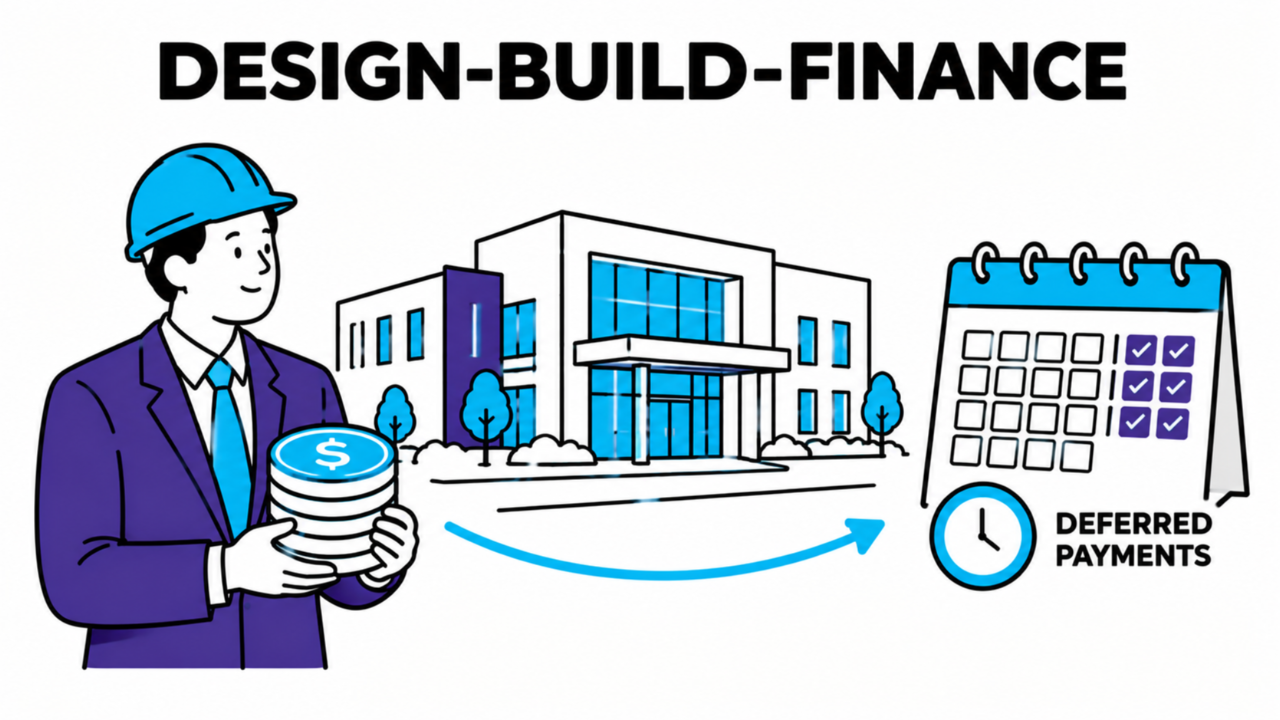
Design-Build-Finance (DBF) Contracts: When Do They Make Sense?
A Design-Build-Finance (DBF) contract is a procurement method in which a contractor designs and builds an asset and also pre-finances its construction. Government does not pay as the work progresses; instead, it pays the contractor in fixed instalments over a number of years after the asset is completed. DBF is sometimes marketed as a PPP or as "innovative financing", but the 2026 APMG PPP Certification Guide does not regard it as a PPP.
This article explains how a DBF contract works, why it is not a PPP, and when it can still make sense for a government.
How a DBF contract works
- Tender. Government tenders a contract for the design, construction and financing of an asset.
- Construction. The contractor builds the asset using its own funds and, more often, bank finance.
- Completion. Government takes over the asset at commissioning, exactly as in a design-build contract, and becomes responsible for its long-term maintenance and condition.
- Deferred payment. Government repays the contractor in fixed instalments, usually over several years, for an amount that covers construction plus financing costs.
In effect, the contractor acts as a lender to government. The lending is often indirect: a bank finances the works against a pledge of the contractor's right to receive government payments, or buys those future payments at a discount, sometimes without recourse. This technique is known as forfaiting.
Why DBF is not a PPP
DBF lacks most of the essential features of a PPP:
- No long-term management. The contractor does not maintain or operate the asset, so there is no life-cycle bundling.
- No life-cycle risk transfer. Government keeps all risks related to the condition of the asset after completion.
- No performance-based pay. Payments are fixed and do not depend on the asset's availability or quality.
- Finance exposed only to construction risk. The private money is at risk only until completion, not for the life of the asset.
For these reasons, the Guide does not treat the financing in a DBF as private finance in the PPP sense. Most national accounting standards also treat DBF as public borrowing, recording the asset and liability on the government's balance sheet, because government controls the asset and bears all the risks once it is built.
Some countries nevertheless classify DBF as a type of PPP, based on the financing and the additional construction risk it transfers. Readers should check how the term is used in their jurisdiction.
DBF compared with other models
| Design-build | DBF | DBOM | DBFOM | |
|---|---|---|---|---|
| Who finances construction | Government, as work progresses | Contractor, repaid after completion | Government | Private partner, at risk |
| Long-term maintenance | Government | Government | Contractor | Private partner |
| Payment linked to performance | No | No | Partly | Yes |
| Regarded as a PPP by the PPP Guide | No | No | Broad sense | Yes |
Potential advantages of DBF
DBF can still be useful. The Guide notes that it may offer advantages over a conventional design-build contract:
- Bridging short-term budget constraints. Government can start a project before funds are available.
- Stronger incentive to finish on time. Because the contractor is paid only on completion, delays cost it money. The reliability of the construction timeline can improve, provided payment is genuinely conditional on completion and commissioning.
- Extra due diligence. The lender reviews the project, though only with respect to construction risk.
Disadvantages and risks
- Higher cost of finance. Even though credit risk is low, the contractor's financing will carry an interest rate premium over government borrowing. Government must check that the benefits outweigh this cost.
- No incentive for quality. As with design-build, the contractor has no long-term stake in the asset and may maximise margin during construction.
- Debt by another name. DBF creates a firm payment obligation for government, and is usually counted as public debt.
- No improvement in maintenance. Long-term asset management remains entirely with government.
When DBF makes sense
DBF may be appropriate when:
- the main constraint is the timing of budget availability rather than efficiency;
- government has the capacity to maintain the asset itself;
- a full PPP would be too complex or costly for the project's size;
- timely completion is a priority and payment can be tied to it.
Governments should also look at how the contractor will raise the money, since the cost and structure of project finance or corporate borrowing affects the final price.
This article is part of our PPP Models and Contract Types: The Complete Guide.
Key takeaways
- In a DBF, the contractor designs, builds and pre-finances an asset, and government pays later in fixed instalments.
- The contractor effectively becomes a lender to government, often through forfaiting.
- The PPP Guide does not regard DBF as a PPP: there is no long-term management, life-cycle risk transfer or performance-based pay.
- DBF is usually treated as public debt in government accounts.
- It can help bridge short-term budget gaps and improve on-time delivery, at a higher financing cost.
Go further
Choosing between PPP models is one of the first decisions in any PPP project. The CP3P Foundation course explains PPP types, contract structures and payment models in line with the 2026 PPP Guide, and prepares you for the internationally recognised CP3P Foundation exam.
Related reading
- PPP Models and Contract Types: The Complete Guide
- Design-Build Contracts: Why They Are Not PPPs
- What Is DBFOM? Design-Build-Finance-Operate-Maintain Explained
- DBOM Contracts: Design-Build-Operate-Maintain Without Private Finance
- What Is a Build-Operate-Transfer (BOT) Contract?
- Corporate Finance vs Project Finance in PPPs
- Project Finance Basics for PPP Practitioners
The PPP Alliance is an independent body of knowledge for the advancement of Public-Private Partnership knowledge and best practices. Interested in joining the community? Become a member today.
The PPP Alliance is an independent body of knowledge for the advancement of Public-Private Partnership knowledge and best practices.
Interested in joining the community? Become a member today.
Stay connected with news and updates!
Join our mailing list to receive the latest news and updates from our team.
Don't worry, your information will not be shared.
We hate SPAM. We will never sell your information, for any reason.