
The Essential Features of a PPP Contract
Apr 15, 2026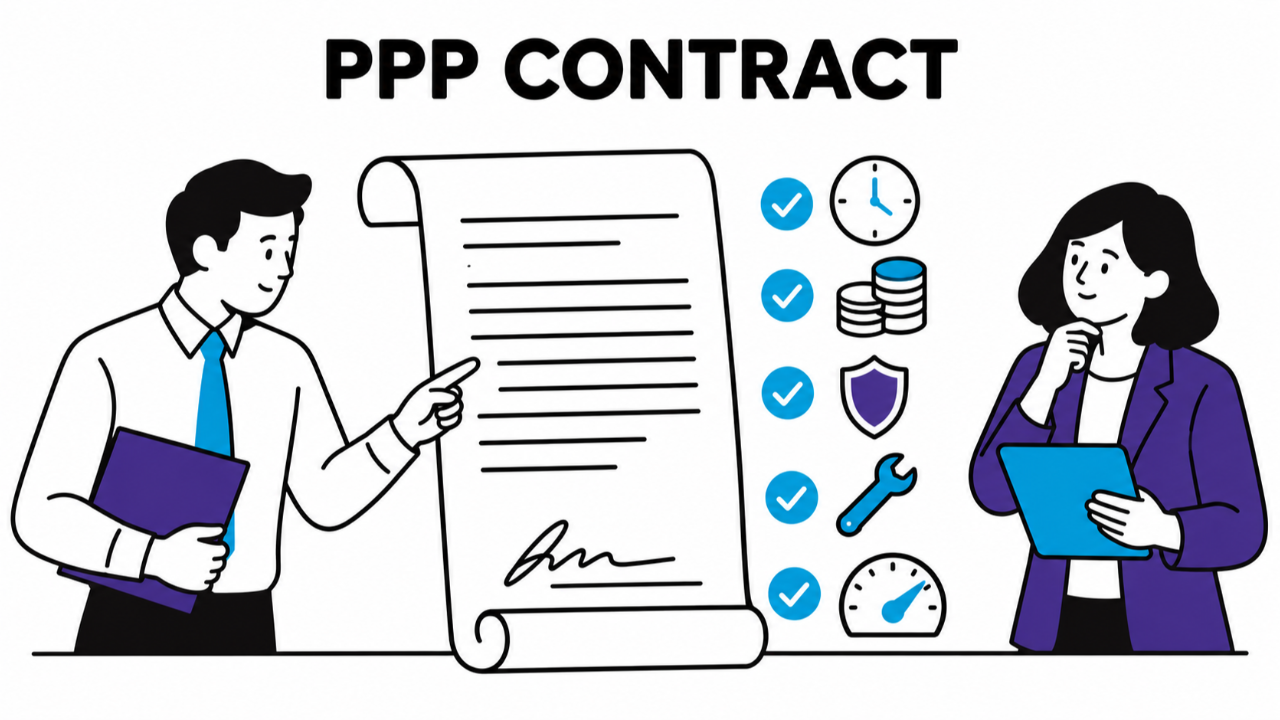
The Essential Features of a PPP Contract
What turns an ordinary government contract into a public-private partnership? The answer lies in a handful of features that a PPP contract must have. According to the 2026 APMG PPP Certification Guide, a true private finance PPP combines five essential features: a long-term contract, bundled construction and management, significant risk transfer, significant private finance at risk, and remuneration linked to performance or demand.
This article explains each feature of a PPP contract, why it matters, and the other features commonly found in PPPs.
Feature 1: A long-term contract between a public and a private party
Long-term. PPP contracts typically run for 20 to 30 years or more. The duration is not arbitrary: it allows risk and responsibility to be transferred over a significant part of the asset's life, and it gives the private partner time to repay the finance it raised.
A contract. The relationship is set out in a written, enforceable contract that defines the rights and obligations of both parties. Usually this is one document with schedules, though some PPPs involve several linked agreements. For example, a power plant PPP may combine a licence from the energy ministry with a Power Purchase Agreement with the state transmission company. The contract is normally awarded through a competitive tender.
A public party and a private party. The public party is the procuring authority, which may be a national ministry, a regional or municipal government, or an agency acting for government. The private party is typically a consortium that creates a project company to sign the contract. A contract between a government and a company it owns itself is not normally regarded as a PPP, because there is little genuine risk transfer.
Feature 2: Bundling the development and management of the asset
A PPP bundles the design and construction of an asset with its long-term maintenance, and often its operation. This bundling is the source of much of a PPP's efficiency. A partner that must maintain what it builds for decades has a direct financial reason to build it well, choose durable materials and plan maintenance sensibly. This is the life-cycle approach in action.
The asset can be new (greenfield) or a significant upgrade or renovation of an existing asset (brownfield). Many PPPs also include managing a related public service, for example operating a transport system as well as building it.
Feature 3: Significant risk transfer and management responsibility
The private party must be materially in charge of managing the asset, especially its life-cycle costs, not just a few minor tasks. Responsibility and risk go together: life-cycle risks should only be transferred if responsibility for long-term maintenance and renewals has been transferred too.
The word "significant" matters. Risk transfer is the main driver of PPP efficiency, so the bulk of the relevant risks should sit with the private partner. But not every risk should be transferred. Risks the private partner cannot control or influence, such as many political or regulatory risks, are usually better retained or shared by government. Transferring them anyway simply makes bids more expensive.
Even when risk is transferred, the public sector does not walk away. It must monitor performance to make sure the private partner meets its obligations.
Feature 4: Significant private finance at risk
In a private finance PPP, the private partner provides a significant portion of the money needed to build the asset, usually through project finance: equity from investors plus debt from lenders, repaid from the project's revenues.
Private finance is not strictly necessary for a contract to be a PPP under the broad definition. But it makes risk transfer far more effective. When the private partner's own capital is at risk and is only repaid if the asset performs, it has a powerful incentive to deliver. Lenders add a further layer of due diligence and oversight. The Guide treats "private finance" as any finance provided by the private sector that is at risk, meaning that its repayment depends on the performance of the project.
Feature 5: Remuneration linked to performance and/or demand
The private partner is paid according to how the asset performs (availability and service quality), how much it is used, or both. This is how the contract aligns the private partner's interest in profit with the public sector's interest in reliable, good-quality service.
- In government-pays PPPs, payments depend mainly on the asset being available and meeting service standards, with deductions for failures. The PPP payment mechanism sets out how this works.
- In user-pays PPPs, revenue depends on demand, through tolls, tariffs or fares.
A related feature is that payments usually start only once the asset is complete and in service. That gives the private partner a strong incentive to finish on time.
Performance should be specified through outputs rather than inputs, leaving room for the private partner to innovate in how it meets the requirements.
Other common features of PPPs
Beyond the five essentials, the PPP Guide identifies several features that are common but not mandatory:
- A special purpose vehicle (SPV). The private partner is usually a new project company created solely to deliver the contract.
- Project finance. Financing is usually raised on the strength of the project's cash flows, not the sponsors' balance sheets.
- Revenue only after completion. The private partner earns little or nothing until the asset is ready to use.
- Output specifications. Requirements focus on results, not methods, which encourages innovation.
Putting the features together: a quick checklist
| Feature | Question to ask | If the answer is no… |
|---|---|---|
| Long-term contract | Does the contract cover a significant part of the asset's life? | Probably a construction or short service contract |
| Bundling | Are construction and long-term maintenance in one contract? | Probably a design-build contract |
| Risk transfer | Does the private party carry significant life-cycle risk? | The VfM rationale is weak |
| Private finance | Is significant private money at risk? | Possibly a DBOM, not a private finance PPP |
| Performance pay | Is remuneration tied to availability, quality or use? | Incentives are not aligned |
This article is part of our PPP Fundamentals: The Complete Guide to Public-Private Partnerships.
Key takeaways
- A private finance PPP has five essential features: long term, bundling, significant risk transfer, private finance at risk, and performance- or demand-linked pay.
- Bundling construction with long-term management drives whole-life efficiency.
- Risk transfer should be significant but selective: each risk goes to the party best able to manage it.
- Private finance at risk sharpens incentives, but is not essential to the broader PPP definition.
- SPVs, project finance and output specifications are common features, not defining ones.
Go further
Want a structured grounding in these concepts? The CP3P Foundation course covers PPP definitions, models, the PPP process cycle and the essentials of project finance, aligned with the 2026 PPP Guide, and prepares you for the internationally recognised CP3P Foundation exam.
Related reading
- PPP Fundamentals: The Complete Guide to Public-Private Partnerships
- What Is a Private Finance PPP?
- PPP vs Traditional Public Procurement
- What Is a Public-Private Partnership (PPP)? A Complete Guide
- The Spectrum of Private Participation in Public Infrastructure
- Risk Transfer: The Engine of PPP Value
- Payment Mechanisms in PPPs Explained
The PPP Alliance is an independent body of knowledge for the advancement of Public-Private Partnership knowledge and best practices. Interested in joining the community? Become a member today.
The PPP Alliance is an independent body of knowledge for the advancement of Public-Private Partnership knowledge and best practices.
Interested in joining the community? Become a member today.
Stay connected with news and updates!
Join our mailing list to receive the latest news and updates from our team.
Don't worry, your information will not be shared.
We hate SPAM. We will never sell your information, for any reason.