
This week’s discussions once again highlighted how central PPPs are to addressing some of today’s most pressing global challenges.
At the World Economic Forum, a key theme that emerged was the need to finance cleaner and more sustainable industries without leaving workers and communities behind. The transition to low-carbon and more resilient infrastructure is no longer a question of if, but how—and PPPs are increasingly seen as a critical instrument to balance private capital, public objectives, and social outcomes. The conversation made clear that sustainability cannot be reduced to emissions alone; it must also account for jobs, skills, affordability, and long-term community impact.
Building on this, I have written an article this week on how to set sustainability criteria in PPPs, focusing on what governments and practitioners should take into consideration when moving from high-level policy ambitions to practical, measurable requirements in project design and procurement. As sustainability becomes embedded in PPP frameworks, getting these criteria right—early and transparently—will be essential for both credibility and bankability.
Together, these topics underline a broader shift we are seeing across the PPP landscape: sustainability is no longer an add-on, but a core element of how PPPs are conceived, structured, and delivered.
I hope this week’s insights contribute to the ongoing discussion and support your work in shaping the next generation of PPP projects.
Kind regards,

PPP Concept of the Week
Every week, we cover a new concept to to learn something about PPPs. Some topics are easy, some a little more advanced. This week's concept is:
Viability Gap Funding (VGF): Viability Gap Funding is a mechanism used by governments to make otherwise commercially unviable PPP projects financially feasible. It provides a one-time or milestone-linked grant, subsidy, or support to bridge the gap between the project’s cost and the revenue it can generate, ensuring that private investors can participate without bearing disproportionate risks. VGF is particularly common in infrastructure sectors such as roads, social infrastructure, and renewable energy, where public benefits are high but commercial returns may be insufficient to attract private financing. The terms, timing, and conditions of VGF are typically defined in the project agreement and linked to performance or construction milestones.
We hope this insight adds to your PPP knowledge and supports your ongoing professional practice.
Setting Sustainability Criteria in Public-Private Partnerships
This week, I have been conducting research for best practices in creating Value-for-Money (VfM) in PPPs.
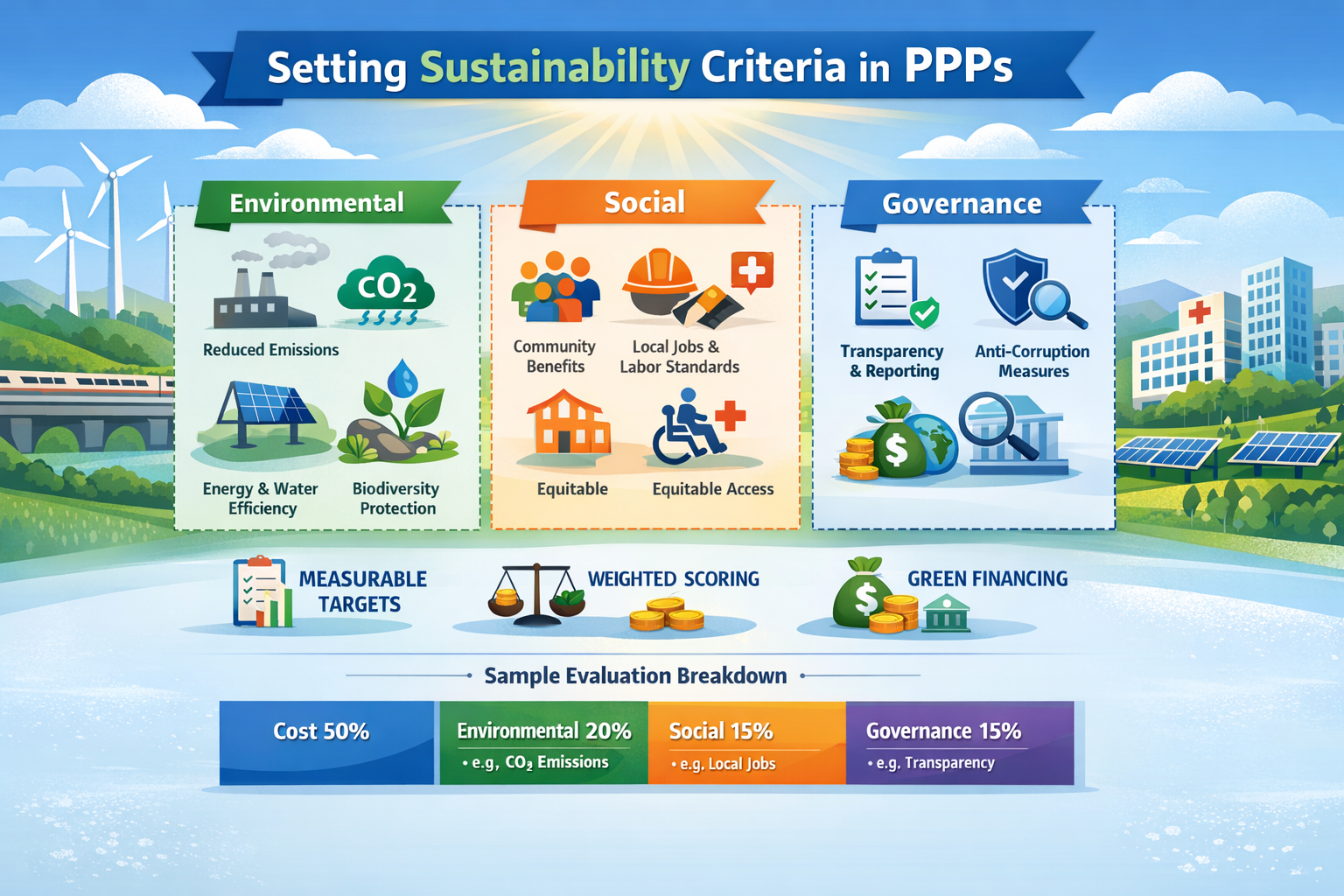
Sustainability has moved from a policy aspiration to a practical requirement in Public–Private Partnerships (PPPs). Governments increasingly face binding expectations from lenders, investors, and international institutions to demonstrate that PPP projects deliver measurable environmental, social, and governance (ESG) outcomes. Multilateral development banks, export credit agencies, and commercial lenders now routinely condition financing on compliance with ESG frameworks such as the IFC Performance Standards, the Equator Principles, and alignment with the UN Sustainable Development Goals (SDGs).
This article provides practical guidance for government officials on how to set, measure, and weight sustainability criteria in PPP projects across sectors. It explains why sustainability criteria are now essential, outlines the main ESG themes relevant to PPPs, and offers clear advice on how to translate sustainability objectives into measurable and bankable evaluation criteria. The article concludes with recommendations on weighting sustainability in procurement and provides illustrative examples of commonly used criteria.




Responses