
Setting Sustainability Criteria in Public–Private Partnerships
Jan 29, 2026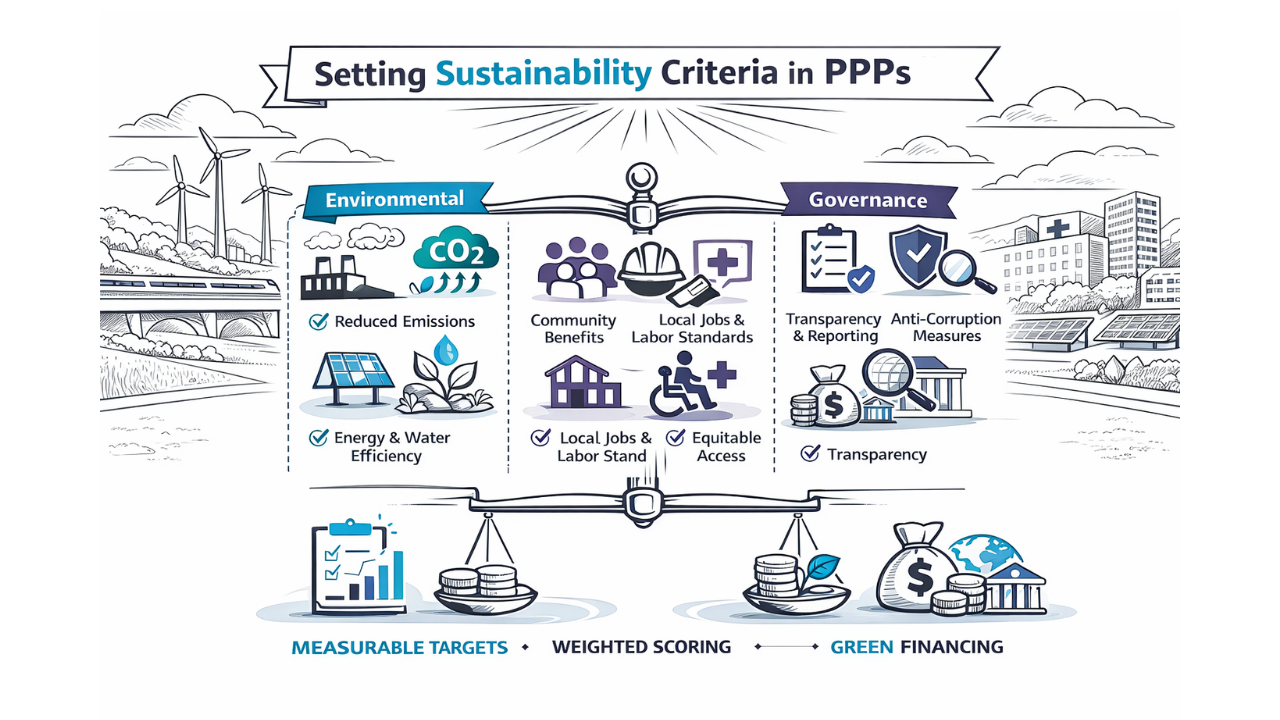
Introduction
Sustainability has moved from a policy aspiration to a practical requirement in Public–Private Partnerships (PPPs). Governments increasingly face binding expectations from lenders, investors, and international institutions to demonstrate that PPP projects deliver measurable environmental, social, and governance (ESG) outcomes. Multilateral development banks, export credit agencies, and commercial lenders now routinely condition financing on compliance with ESG frameworks such as the IFC Performance Standards, the Equator Principles, and alignment with the UN Sustainable Development Goals (SDGs).
This article provides practical guidance for government officials on how to set, measure, and weight sustainability criteria in PPP projects across sectors. It explains why sustainability criteria are now essential, outlines the main ESG themes relevant to PPPs, and offers clear advice on how to translate sustainability objectives into measurable and bankable evaluation criteria. The article concludes with recommendations on weighting sustainability in procurement and provides illustrative examples of commonly used criteria.
1. Why Sustainability Criteria Are Now Essential in PPPs
PPP projects are long-term contracts, often spanning 20–30 years, with significant economic, environmental, and social impacts. At the same time, infrastructure accounts for a large share of global greenhouse gas emissions and directly affects communities, ecosystems, and public trust in government. As a result, sustainability has become a core determinant of project viability.
From a financing perspective, sustainability criteria are no longer optional. Most international lenders and development finance institutions require borrowers to demonstrate compliance with environmental and social safeguards, climate resilience measures, and governance standards before approving financing. Projects that cannot demonstrate credible sustainability performance face higher financing costs, delays, or outright rejection.
From a public policy perspective, sustainability criteria help governments ensure that PPPs contribute to national development objectives, climate commitments, and social inclusion goals. Clear criteria also reduce ambiguity during procurement, improve bid quality, and strengthen public accountability over the life of the contract.
In short, well-designed sustainability criteria help governments:
- Secure access to financing on competitive terms
- Reduce long-term environmental and social risks
- Improve value for money over the full project lifecycle
- Increase public acceptance and political legitimacy of PPPs
Together, these benefits demonstrate that sustainability criteria are not an additional administrative burden, but a strategic tool for governments. When sustainability is clearly articulated and credibly enforced, PPPs are more likely to attract high-quality bidders, secure long-term financing, and deliver outcomes that remain politically and socially viable over the full contract term.
2. Core Sustainability Themes in PPP Projects
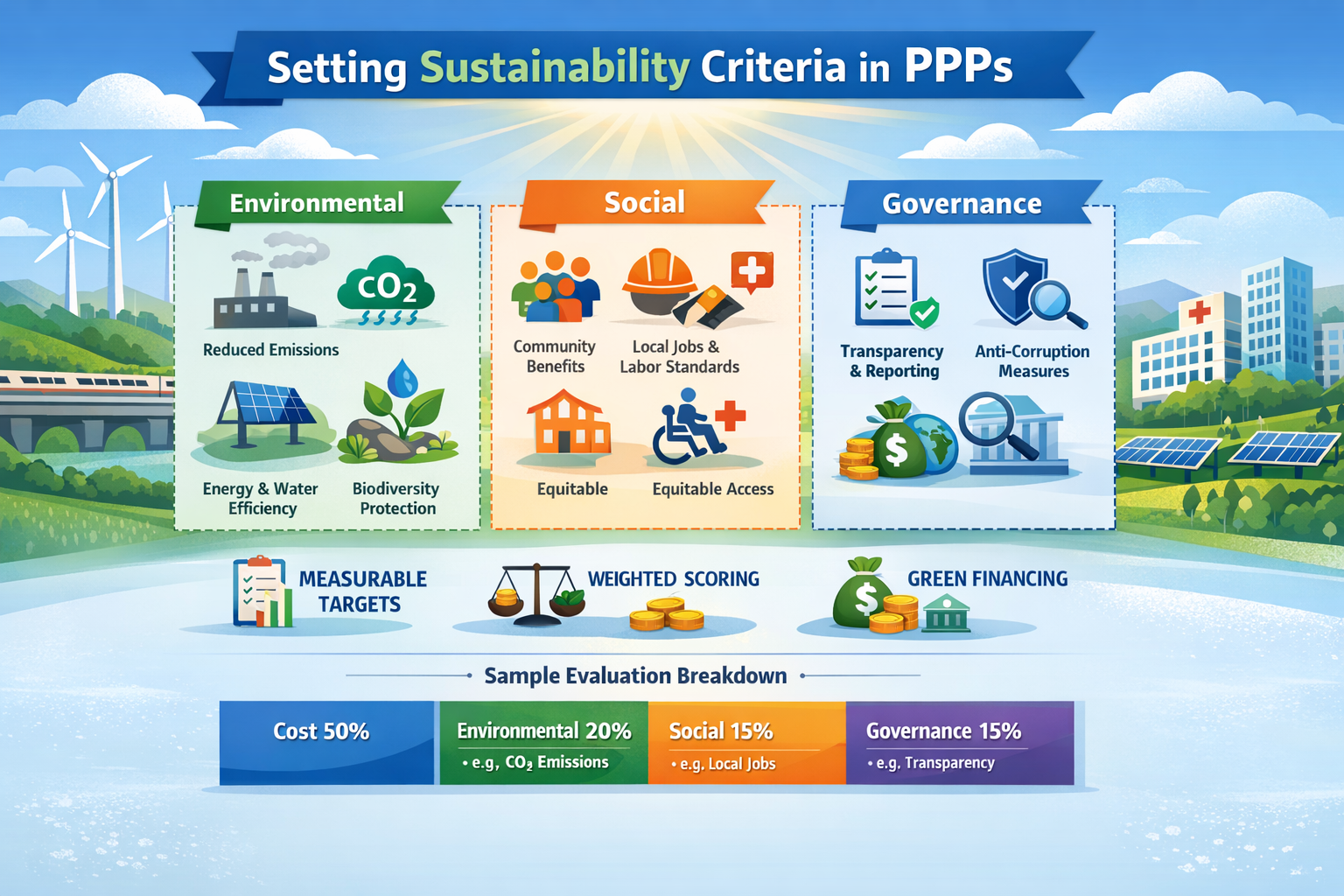
Sustainability criteria in PPPs are typically structured around three interconnected pillars: Environmental, Social, and Governance (ESG). While the relative importance of each pillar may vary by sector and country context, all three should be addressed explicitly.
2.1 Environmental Sustainability
Environmental criteria focus on minimizing negative environmental impacts and improving long-term resilience. Common themes include:
- Greenhouse gas emissions and climate change mitigation
- Energy efficiency and use of renewable energy
- Water efficiency and water resource management
- Waste reduction and circular economy practices
- Biodiversity protection and land-use management
- Climate adaptation and resilience to extreme weather
Environmental criteria are particularly important to lenders, who increasingly require projects to demonstrate alignment with national climate targets or international taxonomies.
2.2 Social Sustainability
Social criteria address how the project affects people and communities. They typically cover:
- Stakeholder engagement and public consultation
- Local employment and skills development
- Health, safety, and labor standards
- Affordability and accessibility of services
- Community benefits and social inclusion
Strong social criteria reduce the risk of community opposition, construction delays, and reputational damage, while increasing the long-term success of the project.
2.3 Governance and Institutional Sustainability
Governance criteria ensure transparency, integrity, and accountability throughout the PPP lifecycle. Key areas include:
- Transparent and competitive procurement processes
- Fair risk allocation and contract clarity
- Anti-corruption and ethical standards
- Performance monitoring and reporting mechanisms
- Contract management capacity
Good governance underpins the credibility of sustainability commitments and ensures they are enforced after financial close.
3. Designing Measurable and Bankable Sustainability Criteria
One of the main challenges for government officials is translating high-level sustainability objectives into criteria that are measurable, comparable, and enforceable. Well-designed sustainability criteria must be clear enough to guide bidder behavior, robust enough to satisfy lenders, and practical enough to be monitored throughout the contract lifecycle.
3.1 Make Criteria Specific and Measurable
Sustainability criteria should be defined using clear, objective, and quantifiable indicators. Vague requirements such as “environmentally friendly design” or “socially responsible operations” should be avoided, as they are difficult to evaluate consistently and even harder to enforce contractually. Instead, each criterion should clearly specify what is being measured (for example, tonnes of CO₂ emissions or the percentage of local employment), how it will be measured (including methodologies, standards, and baselines), when it will be measured (during construction, operations, or on an annual basis), and who is responsible for reporting and verification. This level of precision enables fair bid comparison during procurement and supports effective performance monitoring once the project is operational.
3.2 Align with Recognized Standards
Aligning sustainability criteria with recognized international standards increases credibility, comparability, and bankability. Frameworks such as the UN Sustainable Development Goals, IFC Performance Standards, Global Reporting Initiative (GRI), and OECD or UNECE PPP principles provide commonly accepted definitions, indicators, and reporting practices. Referencing these frameworks reduces ambiguity for bidders, lowers transaction costs, and reassures lenders that sustainability commitments are based on established methodologies rather than bespoke or untested requirements.
3.3 Support Criteria with Evidence and Monitoring Plans
Sustainability criteria should be grounded in evidence and supported by clear monitoring arrangements. Governments are encouraged to use available baseline data, such as environmental impact assessments, climate risk studies, or social assessments, to set realistic and relevant targets. PPP contracts should explicitly define monitoring, reporting, and verification requirements, including the frequency of reporting, the format of sustainability data, and the role of independent audits where appropriate. Clear monitoring provisions ensure that sustainability commitments made at the bidding stage translate into measurable outcomes throughout the life of the project.
4. Weighting Sustainability in PPP Evaluation
The effectiveness of sustainability criteria in PPP procurement depends less on their mere inclusion and more on how they are weighted, structured, and enforced within the evaluation framework. Weighting sends a clear signal to the market about government priorities. If sustainability carries insufficient weight, bidders will treat it as a compliance exercise rather than a driver of innovation and value creation.
4.1 Assign Meaningful Weight
Sustainability criteria should be given enough weight to materially influence bid outcomes. In practice, this means moving beyond symbolic scores and ensuring that environmental and social criteria together represent a substantial share of the non-price evaluation. Many governments allocate between 20% and 40% of the total evaluation score to sustainability-related factors, with the exact weighting determined by sector characteristics, policy priorities, and risk profile.
For example, in a transport PPP, environmental criteria such as lifecycle greenhouse gas emissions, energy efficiency, and climate resilience might account for 15–20% of the total score, while social criteria such as local employment, road safety, and stakeholder engagement account for an additional 10–15%. Governance-related criteria are often embedded across all sections, including bid quality, risk allocation, and contract management capability.
Crucially, sustainability weighting should be defined early in project preparation and reflected consistently across the procurement documents, including the request for proposals, evaluation manuals, and draft contract.
4.2 Use Minimum Thresholds to Protect Outcomes
Weighted scoring alone may not be sufficient to safeguard sustainability outcomes. Governments are therefore encouraged to complement weighting with minimum sustainability thresholds. These thresholds establish non-negotiable requirements that bidders must meet in order to remain eligible for award.
Typical threshold criteria include compliance with environmental and social safeguards, minimum climate resilience standards, adherence to labor and health-and-safety regulations, and credible sustainability management systems. If a bid fails to meet these minimum standards, it is excluded from further evaluation, regardless of price or technical score. This approach prevents situations where weak sustainability performance is effectively traded off against lower cost.
4.3 Balance Cost with Lifecycle Value
Sustainability weighting should be closely linked to lifecycle value rather than upfront cost alone. PPPs are long-term arrangements, and many sustainability measures — such as energy-efficient design or resilient materials — may increase initial capital expenditure while reducing operating costs, environmental impacts, and risk over time.
Evaluation frameworks should therefore incorporate whole-life costing approaches that consider capital costs, operating and maintenance expenses, energy and resource consumption, and, where feasible, environmental externalities. This allows sustainability-enhancing solutions to compete fairly against lower-cost but higher-risk alternatives.
4.4 Illustrative Example: Weighting in a Renewable Energy PPP
Consider a government procuring a solar power PPP. The total evaluation score is set at 100 points. Price accounts for 60 points, while quality accounts for 40 points. Within the quality score, sustainability is allocated 30 points, broken down as follows: 15 points for environmental performance (including lifecycle emissions, land use, and recycling of panels), 10 points for social criteria (local employment, community benefit programs, and occupational safety), and 5 points for governance and reporting arrangements.
In addition, bidders must meet minimum thresholds on environmental impact assessment approval, compliance with international labor standards, and submission of a credible sustainability monitoring plan. A bid offering the lowest tariff but weak environmental mitigation measures would therefore be excluded or outscored by a slightly higher-priced bid delivering stronger long-term sustainability and lower risk.
This combination of meaningful weighting, minimum thresholds, and lifecycle-based evaluation ensures that sustainability is embedded as a core value-for-money consideration rather than an afterthought.
5. Illustrative Sustainability Criteria for PPPs
To be effective, sustainability criteria must translate policy objectives into concrete, measurable indicators that can be consistently evaluated at bid stage and monitored during contract execution. The table below illustrates commonly used sustainability criteria in PPPs, together with practical guidance on how each criterion can be calculated and assessed.
| Sustainability Criterion | What the Criterion Measures | Practical Calculation / Assessment Method | Typical Use in Evaluation |
|---|---|---|---|
|
Greenhouse Gas (GHG) Emissions |
Climate impact of the project over its lifecycle |
Estimate annual and lifecycle CO₂-equivalent emissions (tCO₂e) using an accepted methodology (e.g. GHG Protocol). Bidders submit a baseline and projected emissions profile; scores are awarded based on percentage reduction versus a defined benchmark. |
Weighted score and/or performance-linked incentives; often 10–20% of quality score in carbon-intensive sectors |
|
Energy Consumption and Renewable Energy |
Energy efficiency and decarbonisation of operations |
Calculate total energy use per unit of service (e.g. kWh per passenger, per m³ of water) and the percentage supplied from renewable sources. Require metering and annual reporting. |
Weighted score; minimum renewable energy thresholds increasingly applied |
|
Water Consumption and Reuse |
Efficiency of water use and pressure on local water resources |
Measure total freshwater abstraction per year and percentage of water reused or recycled. Benchmarks can be set using sector norms or local water-stress indicators. |
Weighted score, higher weight in water-scarce regions |
|
Waste Reduction and Recycling |
Contribution to circular economy principles |
Calculate total waste generated during construction and operations and the percentage diverted from landfill through reuse or recycling. Require a waste management plan with quantified targets. |
Weighted score and contractual KPIs |
|
Local Workforce and Local Suppliers |
Local economic development and capacity building |
Measure percentage of total workforce hired locally and percentage of contract value awarded to local suppliers or SMEs. Require reporting by employment category and spend. |
Weighted score; often combined with minimum thresholds |
|
Stakeholder Engagement |
Quality and effectiveness of community engagement |
Assess the robustness of the stakeholder engagement plan, including consultation methods, grievance mechanisms, and responsiveness. Scoring based on predefined qualitative criteria supported by evidence. |
Qualitative score with minimum compliance requirements |
|
Sustainability Reporting and Transparency |
Governance and accountability of sustainability commitments |
Require regular sustainability reporting aligned with recognized frameworks (e.g. GRI or SDGs), including third-party verification where appropriate. |
Threshold requirement and/or governance score |
In practice, governments should select a limited number of criteria that are material to the project and local context, define clear calculation methodologies in the procurement documents, and ensure that each criterion is linked to contractually enforceable obligations. Where possible, sustainability performance should be reinforced through incentives, penalties, or payment mechanisms, ensuring that commitments made at bid stage translate into measurable outcomes during operations.
Conclusion
Setting clear, measurable, and well-weighted sustainability criteria is now a core responsibility of governments implementing PPPs. Done well, these criteria help secure financing, improve project outcomes, and ensure that PPPs deliver lasting economic, environmental, and social value.
By aligning sustainability criteria with international standards, embedding them meaningfully in procurement decisions, and enforcing them through robust contract management, governments can move from sustainability rhetoric to measurable results. This approach not only meets lender requirements but also strengthens the long-term success and legitimacy of PPP programs.
The PPP Alliance is an independent body of knowledge for the advancement of Public-Private Partnership knowledge and best practices.
Interested in joining the community? Become a member today.
Stay connected with news and updates!
Join our mailing list to receive the latest news and updates from our team.
Don't worry, your information will not be shared.
We hate SPAM. We will never sell your information, for any reason.