
Happy New Year, and all the best for 2026! Where most of the PPP community has taken a well-deserved break, 2026 starts of with quite some exciting news, which shows the ever growing importance of PPPs.
First of all, APMG-International together with the World Bank has (finally) anounced that version 2 of the CP3P Examination scheme will be rolled out in 2026. The first version of the PPP Guide was launched in 2016, which marked the official launch of the CP3P scheme (I was there!). However, a lot has changed this decade, and the refreshed Guide will take these aspects ino consideration. I have created a short article that covers the most important changes to guide and the certification scheme.
The second major news update from this weeek is that India’s Finance Ministry unveiled an ambitious PPP pipeline covering 852 projects across central ministries and states, with a total estimated investment exceeding Rs 17 lakh crore (approx. $200 billion-plus) over the next three years. These cover infrastructure sectors including roads, power, railways, ports, and airports, aimed at accelerating infrastructure build-out and private sector participation.
Why are both these development important? Well, they showcase a growing interest in the development and further professionalization of PPPs. Which is exactly what we are trying to accomplish with the PPP Alliance.
It promises to become a great year for PPPs.
Kind regards,

PPP Concept of the Week
Every week, we cover a new concept to to learn something about PPPs. Some topics are easy, some a little more advanced. This week's concept is:
Consortium Agreement: A Consortium Agreement is a contract between two or more private parties that jointly bid for and, if successful, deliver a PPP project. It defines the roles and responsibilities of each consortium member, governance and decision-making arrangements, risk allocation among the parties, financial commitments, and rules for changes in ownership or exit. The agreement is typically in place prior to financial close and may be superseded or complemented by shareholders’ agreements once the Special Purpose Vehicle (SPV) is established.
We hope this insight adds to your PPP knowledge and supports your ongoing professional practice.
Value for Money (VfM) in PPPs
This week, I have been conducting research for best practices in creating Value-for-Money (VfM) in PPPs.
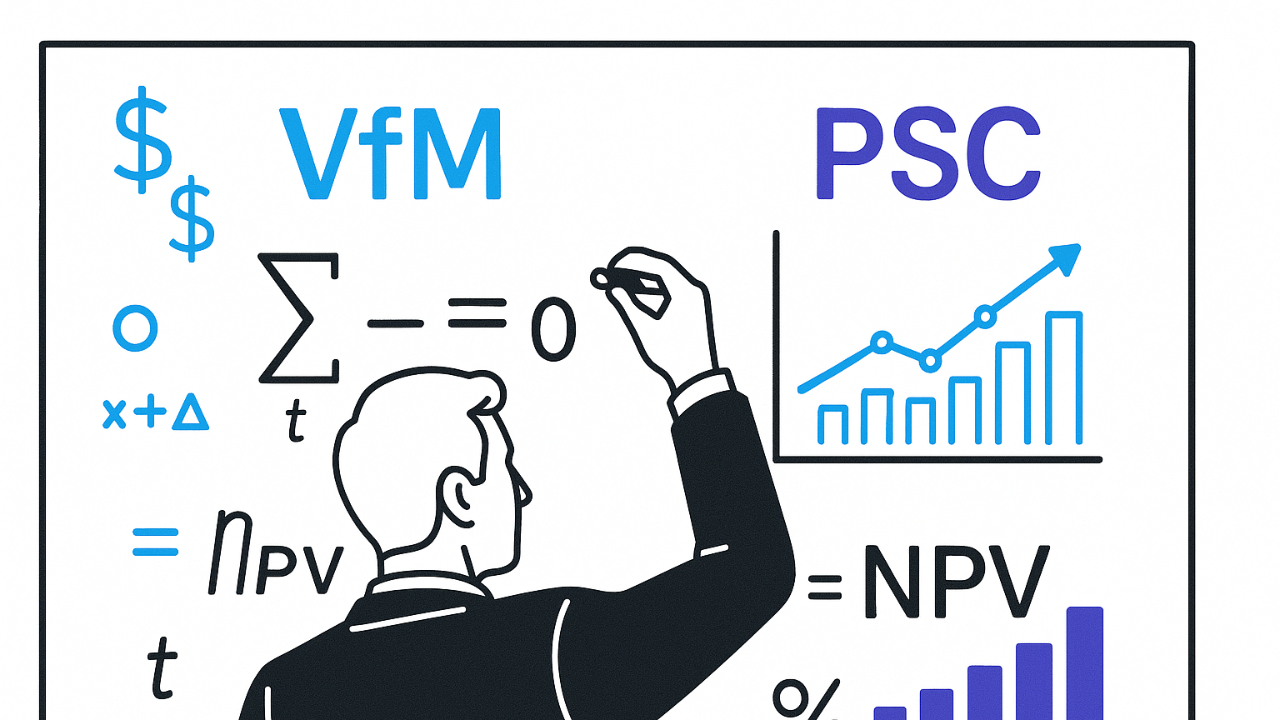
Value for Money in the context of a Public-Private Partnerships means securing the best long-term outcome for the public sector by comparing a PPP solution against traditional public procurement. In practice, VfM is “the optimal combination of life-cycle costs and quality (or fitness for purpose) of a good or service to meet the user’s requirement”.
It is assessed relatively – i.e. by comparing the value and cost of the PPP option versus the conventional alternative. In other words, a PPP is judged to provide VfM if its risk‐adjusted whole‐life cost (present value) is lower than that of the traditional delivery route for the same service or asset. World Bank guidance explains that, for a project to be suitable as a PPP, “it needs to demonstrate that it can achieve higher value for money for the public over the life of the project when compared to other procurement structures, especially traditional public procurement”.
In short, VfM isn’t just about lowest construction cost – it is about delivering service quality, risk transfer and innovation in relation to the total cost.

Responses