
What Is and Is Not a PPP? Drawing the Line
Sep 29, 2026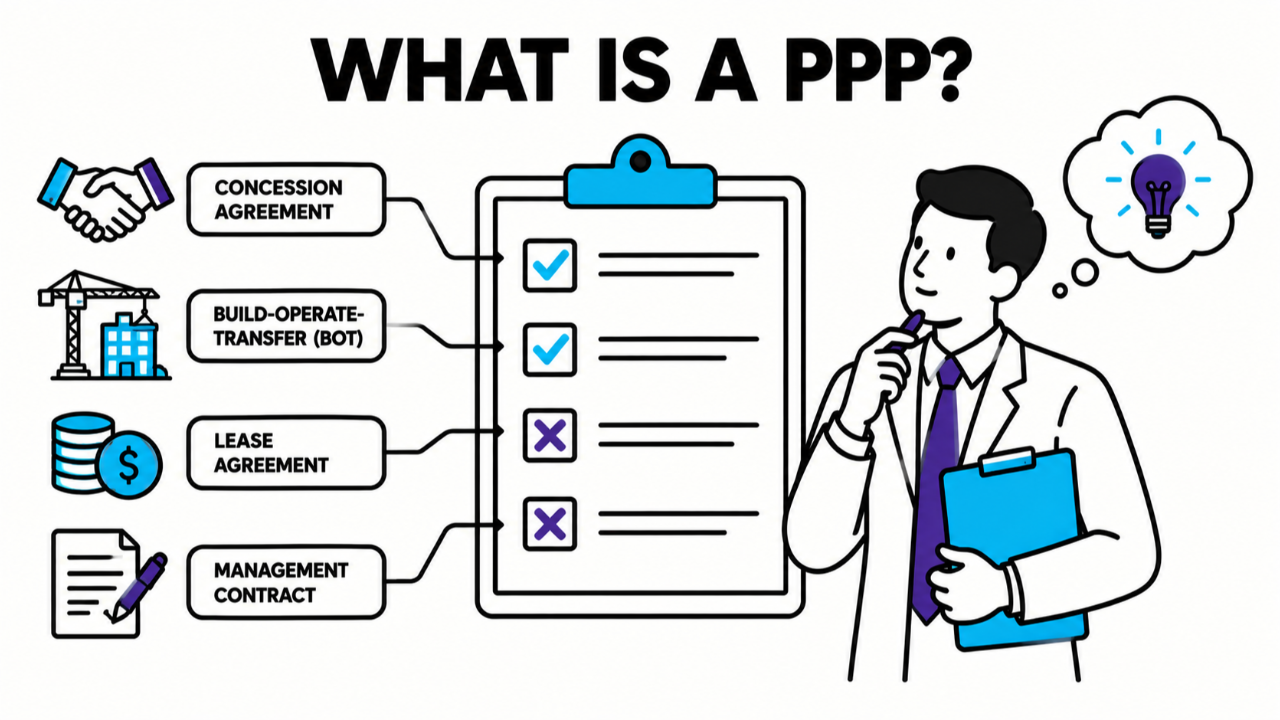
What Is and Is Not a PPP? Drawing the Line
Not every contract between a government and a private company is a PPP. Private involvement alone does not make something a public-private partnership, and neither does private finance, a bundled scope or revenue from users. According to the 2026 APMG PPP Certification Guide, only a procurement contract can be a PPP, and only when it is long-term, bundles construction and management, transfers significant risk and links pay to performance.
This article sets out a practical test for what is not a PPP, and works through the borderline cases that most often cause confusion.
The starting point: only a contract can be a PPP
A PPP is a procurement method. It implies that government has deliberately decided to contract out the development and/or management of an asset or service, under a contract that sets the rights and obligations of both sides. That immediately rules out arrangements where there is no such contract, such as privatised utilities operating under general regulation.
The Guide is explicit that none of the following, on their own, makes an arrangement a PPP:
- the mere involvement of the private sector;
- bundling design, construction and maintenance in one contract;
- the provision of finance by the private sector;
- revenue coming from users rather than the budget.
What matters is the combination of the essential features of a PPP contract.
A five-question test
Ask these questions of any contract. If the answer to any of the first four is no, it is not a PPP. If the answer to the fifth is no, it may be a PPP in the broad sense but not a private finance PPP.
- Is there a formal contract between a public and a private party, awarded for this asset or service?
- Is it long-term, covering a significant part of the asset's life?
- Is long-term management bundled with construction (or, for service PPPs, is the private party responsible for managing the asset or service)?
- Is significant risk transferred, and is pay linked to performance or use?
- Does the private party provide significant finance at its own risk?
Arrangements that are not PPPs
Build-only and design-build contracts
These are traditional procurement. The contractor builds the asset, is paid as work progresses, and hands it over. There is no long-term responsibility and no performance-based pay. Design-build contracts can be excellent tools, but they are not PPPs.
Design-build-finance (DBF) contracts
Here the contractor pre-finances construction and government repays it in fixed instalments after completion. Some countries call this a PPP or "innovative financing". The Guide does not, because the private finance is exposed only to construction risk, not long-term performance, and government keeps all long-term asset risk. It is usually treated as public debt in government accounts.
Short-term O&M or service contracts
A two-year road maintenance contract, or an outsourced service paid at a fixed fee with no real performance risk, is a conventional management or service contract, not a PPP.
Contracts with government-owned companies
A contract between a procuring authority and a company owned by that same government is not normally a PPP, even if the company is legally "private". The Guide's reasoning is that there are reasonable doubts that any risk actually leaves the public sector. A state-owned company owned by a different government, competing in the market like any other operator, is a different matter.
100% public "public-public partnerships"
Structures in which public bodies partner with each other, with no private equity, are not PPPs.
Privatisation and regulated private utilities
Privatisation permanently transfers ownership. Privatised or liberalised utilities, such as telecom operators or electricity distributors competing in a regulated market, invest at their own initiative under general rules, not under a procurement contract. They are not PPPs.
Regulated authorisations and public domain concessions
A renewable energy developer that buys land and sells power under a general subsidy scheme, without a contract with a public counterparty, is not in a PPP. Nor is a long public domain concession (for example, port land granted for up to 99 years) where government acts only as a passive regulator.
Partial divestiture through share sales
Selling a minority stake in a public operator on the stock market brings in private investors but no contract and no change of management. It is a partial privatisation, not a PPP.
Borderline cases that can be PPPs
DBOM contracts
Design-Build-Operate-Maintain contracts bundle construction and long-term maintenance, but government finances the works. If maintenance risk is genuinely transferred along with construction risk, a DBOM comes close to the PPP concept, and many countries classify it as one. The Guide treats it as a PPP in the broad sense, but not a private finance PPP.
Long-term "at-risk" service and management contracts
A contract covering only the operation or maintenance of an existing asset or service can be a service PPP, provided it is relatively long-term, transfers significant risk and is performance-based. Examples include a 15-year bus operating concession where the operator renews the fleet, or a 10-year waste collection contract with quality deductions.
Power Purchase Agreements
An Independent Power Producer that designs, builds, finances and operates a plant under a long-term PPA with a public offtaker, awarded through a tender against government specifications, is a PPP, similar in scope to a DBFOM.
Institutional PPPs
Joint ventures in which government co-owns the project company can be PPPs, but the Guide regards them as proper PPPs only when there is significant private equity investment.
DBFOM contracts without real risk
Even a DBFOM, the archetypal PPP, can fall short. If investors carry no material risk and payments do not genuinely depend on performance, it delivers value much like a DBOM with private money attached.
Quick reference
| Arrangement | PPP? |
|---|---|
| Build-only / design-build | No |
| DBF | No (some countries say yes) |
| Short-term O&M contract | No |
| Contract with own state-owned company | No |
| Privatisation / regulated utility | No |
| DBOM | Broad sense only |
| Long-term at-risk service contract | Yes (service PPP) |
| IPP under a tendered PPA | Yes |
| Institutional PPP with significant private equity | Yes |
| DBFOM with real risk transfer | Yes (private finance PPP) |
This article is part of our PPP Fundamentals: The Complete Guide to Public-Private Partnerships.
Key takeaways
- Only a procurement contract that is long-term, bundled, risk-transferring and performance-based can be a PPP.
- Private involvement, private finance or user revenue alone do not make an arrangement a PPP.
- DB, DBF, short O&M contracts, privatisations and contracts with a government's own companies are not PPPs.
- DBOMs and long-term service contracts can be PPPs in the broad sense; DBFOMs with real risk are private finance PPPs.
- Always test the substance of the contract, not its label.
Go further
Want a structured grounding in these concepts? The CP3P Foundation course covers PPP definitions, models, the PPP process cycle and the essentials of project finance, aligned with the 2026 PPP Guide, and prepares you for the internationally recognised CP3P Foundation exam.
Related reading
- PPP Fundamentals: The Complete Guide to Public-Private Partnerships
- The Spectrum of Private Participation in Public Infrastructure
- What Is a Private Finance PPP?
- Infrastructure vs Public Services: What Can a PPP Deliver?
- What Is a Public-Private Partnership (PPP)? A Complete Guide
- Design-Build Contracts: Why They Are Not PPPs
- Management Contracts, Leases and Affermage Explained
The PPP Alliance is an independent body of knowledge for the advancement of Public-Private Partnership knowledge and best practices. Interested in joining the community? Become a member today.
The PPP Alliance is an independent body of knowledge for the advancement of Public-Private Partnership knowledge and best practices.
Interested in joining the community? Become a member today.
Stay connected with news and updates!
Join our mailing list to receive the latest news and updates from our team.
Don't worry, your information will not be shared.
We hate SPAM. We will never sell your information, for any reason.