
Infrastructure vs Public Services: What Can a PPP Deliver?
Mar 31, 2026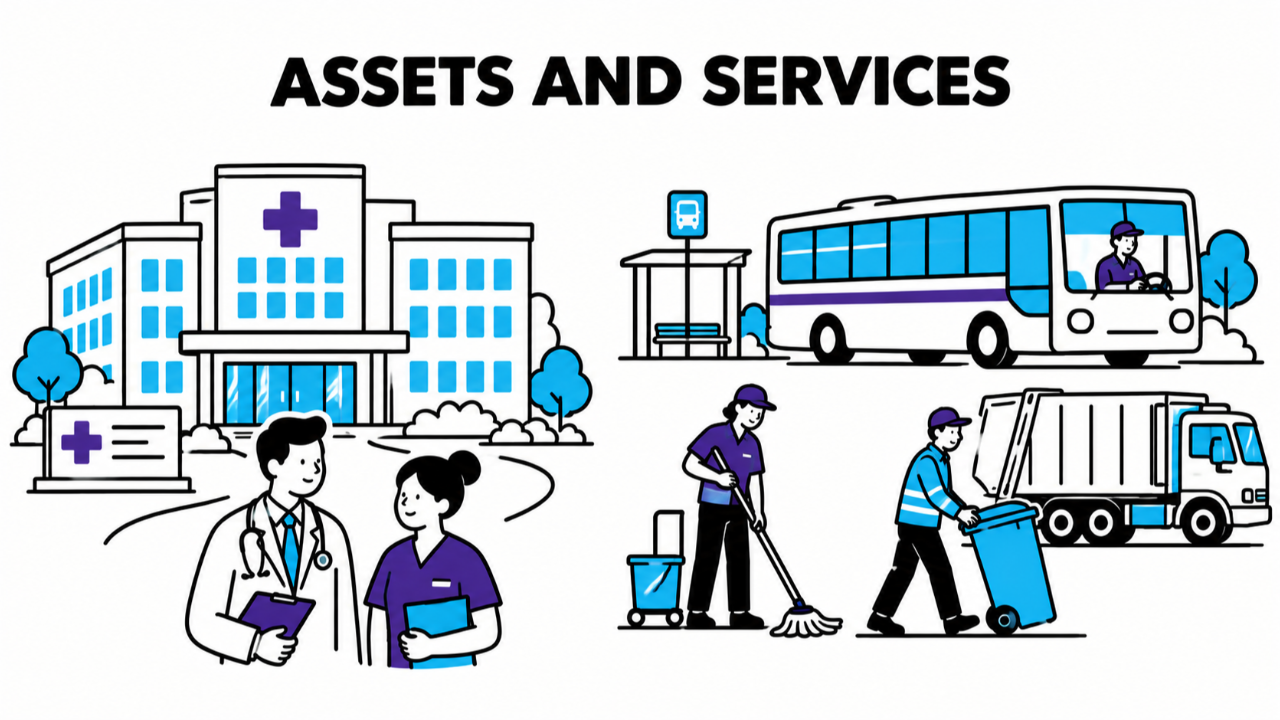
Infrastructure vs Public Services: What Can a PPP Deliver?
A PPP can deliver much more than a building or a road. Public-private partnerships are used to deliver new infrastructure, to upgrade and manage existing assets, and to operate public services themselves. The 2026 APMG PPP Certification Guide distinguishes between infrastructure PPPs, which develop or significantly upgrade assets, and service PPPs, which manage existing infrastructure or provide public services.
This article explains what each type of PPP can deliver, where the boundaries lie, and what to consider when a PPP includes public services.
Infrastructure PPPs: delivering and managing assets
Infrastructure PPPs are used to develop new assets (greenfield) or to make significant upgrades or renovations to existing ones (brownfield). The private partner designs, builds, usually finances, and then maintains the asset, and sometimes operates it.
"Infrastructure" is used in a broad sense. The Guide includes not only large civil works such as roads, bridges and tunnels, but also:
- equipment, such as rolling stock for a railway;
- plants, such as independent power producers and wastewater treatment plants, where civil works may be a smaller part of the scope;
- social infrastructure, such as hospitals, schools and courthouses;
- economic infrastructure, related to water, energy, transport and telecommunications.
The difference between these categories shapes how a PPP is paid for, as explained in the article on economic vs social infrastructure PPPs.
Service PPPs: managing existing assets and services
PPPs can also cover contracts with little or no new construction, where the private partner manages an existing asset or delivers a public service. To count as a PPP, such a contract must be relatively long-term, transfer significant risk, and link pay to performance. The Guide gives examples such as:
- a 7-year contract to manage tariff collection for a city's water service, with penalties and bonuses based on billing performance;
- a 15-year bus operating concession in which the operator renews the fleet and runs the service, paid through fares plus subsidies or a payment per kilometre;
- a 7-year IT management contract to supply and maintain a government department's equipment and systems;
- a 12-year contract to refurbish and manage a public building, including cleaning, catering and maintenance, paid through availability payments with quality deductions;
- a 10-year waste collection contract at a fixed annual fee with quality deductions;
- a 10-year concession for clinical services in a public hospital, usually including medical equipment.
Contracts that only provide short-term services at a fixed price, with no real performance risk, remain conventional service contracts.
Asset plus service: the integrated PPP
Many infrastructure PPPs also include operating a related public service, where the infrastructure is the platform for that service. A metro PPP may cover both building the line and running the trains. A water PPP may cover both a new treatment plant and the supply of water to customers.
Bundling the service with the asset can increase efficiency, because the operator has a stake in how the asset is designed. But it also raises the stakes, because the private partner is now directly involved in delivering a service to the public.
Hard services and soft services
In social infrastructure PPPs, a common distinction is between:
- Hard facilities management: maintenance of the building and its systems, such as structure, mechanical and electrical systems and lifecycle replacement. Almost always part of a PPP.
- Soft facilities management: services such as cleaning, catering, laundry, security and portering. Sometimes included, sometimes left out to preserve flexibility.
- Core public services: teaching in a school, clinical care in a hospital or custody in a prison. Usually retained by government, although some countries include them.
Deciding what to include is a policy choice as much as a technical one.
What to consider before including services
Can the service be measured? Payment depends on performance, so outputs must be specified and monitored objectively. Services that are hard to measure make poor PPP candidates.
How much flexibility is needed? Services change more often than buildings. A 25-year catering contract may become outdated quickly. Shorter service contracts within a longer asset PPP, or market testing at intervals, can help.
What is politically and socially acceptable? Contracting out core services such as healthcare or education can be sensitive. Clear communication that government remains responsible for outcomes is essential.
Who carries demand risk? Where the private partner collects fees from users, demand risk transfers to it; where government pays, it typically stays public.
What happens to existing staff? Service PPPs may involve transferring public employees, which requires careful planning and consultation.
Examples by sector
| Sector | Typical infrastructure scope | Possible service scope |
|---|---|---|
| Transport | Roads, rail lines, stations | Toll collection, train or bus operation |
| Water | Treatment plants, networks | Water supply and billing |
| Health | Hospital buildings, equipment | Facilities management, sometimes clinical services |
| Education | Schools, universities | Facilities management, rarely teaching |
| Energy | Power plants | Sale of electricity under a PPA |
| Government | Offices, courts, prisons | Facilities management, sometimes custodial services |
The full range of PPP sectors is covered in a separate guide.
This article is part of our PPP Fundamentals: The Complete Guide to Public-Private Partnerships.
Key takeaways
- Infrastructure PPPs develop or significantly upgrade assets; service PPPs manage existing assets or deliver public services.
- "Infrastructure" includes equipment and plants as well as civil works, and covers both economic and social assets.
- Service contracts are PPPs only if they are long-term, transfer significant risk and pay for performance.
- Many PPPs bundle an asset with a related service, which can increase efficiency but adds complexity.
- Whether to include services depends on measurability, flexibility, public acceptance and demand risk.
Go further
Want a structured grounding in these concepts? The CP3P Foundation course covers PPP definitions, models, the PPP process cycle and the essentials of project finance, aligned with the 2026 PPP Guide, and prepares you for the internationally recognised CP3P Foundation exam.
Related reading
- PPP Fundamentals: The Complete Guide to Public-Private Partnerships
- What Is a Public-Private Partnership (PPP)? A Complete Guide
- PPP vs Traditional Public Procurement
- The Spectrum of Private Participation in Public Infrastructure
- What Is and Is Not a PPP? Drawing the Line
- Economic vs Social Infrastructure PPPs
- Which Infrastructure Sectors Are Suitable for PPPs?
The PPP Alliance is an independent body of knowledge for the advancement of Public-Private Partnership knowledge and best practices. Interested in joining the community? Become a member today.
The PPP Alliance is an independent body of knowledge for the advancement of Public-Private Partnership knowledge and best practices.
Interested in joining the community? Become a member today.
Stay connected with news and updates!
Join our mailing list to receive the latest news and updates from our team.
Don't worry, your information will not be shared.
We hate SPAM. We will never sell your information, for any reason.