
The Importance of PPP Contract Management
Feb 05, 2026
Why PPP Contract Management Is the Missing Link in Public–Private Partnerships
Public–Private Partnerships (PPPs) are often judged by the quality of their preparation. Governments invest heavily in feasibility studies, transaction advisors, financial modeling, and competitive procurement processes. Yet experience across jurisdictions shows that many PPP failures do not originate at procurement, but during implementation. Once contracts are signed and financial close is reached, attention often shifts elsewhere, leaving governments ill-equipped to manage what are typically 20- to 30-year contractual relationships.
This gap between deal-making and deal-keeping is precisely where a PPP Contract Management Function becomes indispensable. Countries that have institutionalized professional contract management, often through a centralized PPP Centre, consistently demonstrate better service delivery, stronger fiscal control, and fewer disputes. Conversely, jurisdictions that underinvest in this function frequently experience renegotiations, cost overruns, service degradation, and loss of public trust.
This article explores why a dedicated PPP Contract Management Function is essential, the value it delivers over the life of a PPP, and the core activities that define effective contract management in practice.
Why Contract Management Matters
A PPP contract is not a static legal document; it is a living framework for a long-term partnership. Over decades, projects face changing demand, evolving regulations, technological disruption, political transitions, and unforeseen risks. No matter how well a contract is drafted, it cannot anticipate every eventuality.
Without active management, the risk allocation and performance mechanisms carefully negotiated during procurement can gradually erode. Availability payments may be made without proper verification, performance failures may go unrecorded, and contract variations may be agreed without a full understanding of their fiscal and legal implications. In extreme cases, governments discover - often too late - that they are exposed to liabilities they never intended to accept.
A dedicated contract management function exists to prevent exactly this outcome. Its purpose is not adversarial enforcement, but protecting value for money, service quality, and public interest throughout the contract lifecycle.
Importantly, contract management is not an administrative afterthought. Leading institutions increasingly recognize it as a specialized professional discipline, requiring a blend of legal, financial, technical, and commercial skills. This recognition has driven the establishment of centralized PPP Centres that support line ministries and contracting authorities with expert contract management capacity.
Why Centralize Contract Management Through a PPP Centre?
While individual ministries remain the legal counterparties to PPP contracts, many countries have found that centralizing contract management capability delivers significant advantages.
First, PPPs are relatively infrequent for most line agencies. A transport ministry may manage only one or two major concessions at a time, while a health authority may not have permanent staff with experience in availability-based hospital PPPs. A PPP Centre, by contrast, accumulates experience across sectors and projects, allowing lessons learned in one project to be applied systematically to others.
Second, centralized units help preserve institutional memory. PPPs often outlast political cycles and staff rotations. When contract managers move on, critical knowledge can be lost unless it is embedded in a permanent structure with standardized tools, guidance, and documentation practices.
Third, a PPP Centre can ensure consistency in approach - from performance monitoring methodologies to variation approval thresholds and dispute resolution strategies. This consistency strengthens the government’s negotiating position and reduces the risk of ad hoc decision-making under pressure.
Finally, locating the contract management function within or close to the Ministry of Finance or Planning authority enhances fiscal oversight. Contract variations, refinancing events, or early termination scenarios can be assessed not only from a project perspective, but also in terms of their impact on public finances and contingent liabilities.
The Value Delivered by an Effective Contract Management Function
At its core, PPP contract management is about ensuring that promised services are delivered at the agreed standard and price, for the full duration of the contract. However, its benefits extend well beyond basic compliance.
A strong contract management function actively protects value for money by ensuring that payments are linked to verified performance, that penalties and incentives are applied as intended, and that risk remains with the party best able to manage it. This discipline discourages opportunistic behavior and reinforces the credibility of the PPP framework.
Equally important is the function’s role in anticipating and managing change. Most PPPs will undergo some form of adjustment during their life - whether due to demand changes, policy shifts, or force majeure events. Contract managers provide the analytical and negotiation capability needed to assess these changes objectively, quantify their impacts, and implement them without undermining the original deal.
Over time, contract management also becomes a powerful learning engine. By tracking performance data, disputes, and renegotiations across projects, PPP Centres can refine standard contract clauses, improve risk allocation, and strengthen future procurements. In this way, good contract management improves not only current projects, but the overall quality of a country’s PPP program.
What Does a PPP Contract Management Function Actually Do?
Although organizational models differ, the core activities of PPP contract management are remarkably consistent across successful jurisdictions.
The function begins well before financial close. Experienced PPP Centres increasingly insist that contract managers are involved during procurement, ensuring that monitoring mechanisms, reporting requirements, and change procedures are practical and enforceable. This early involvement prevents the common problem of inheriting a contract that is theoretically sound but operationally unmanageable.
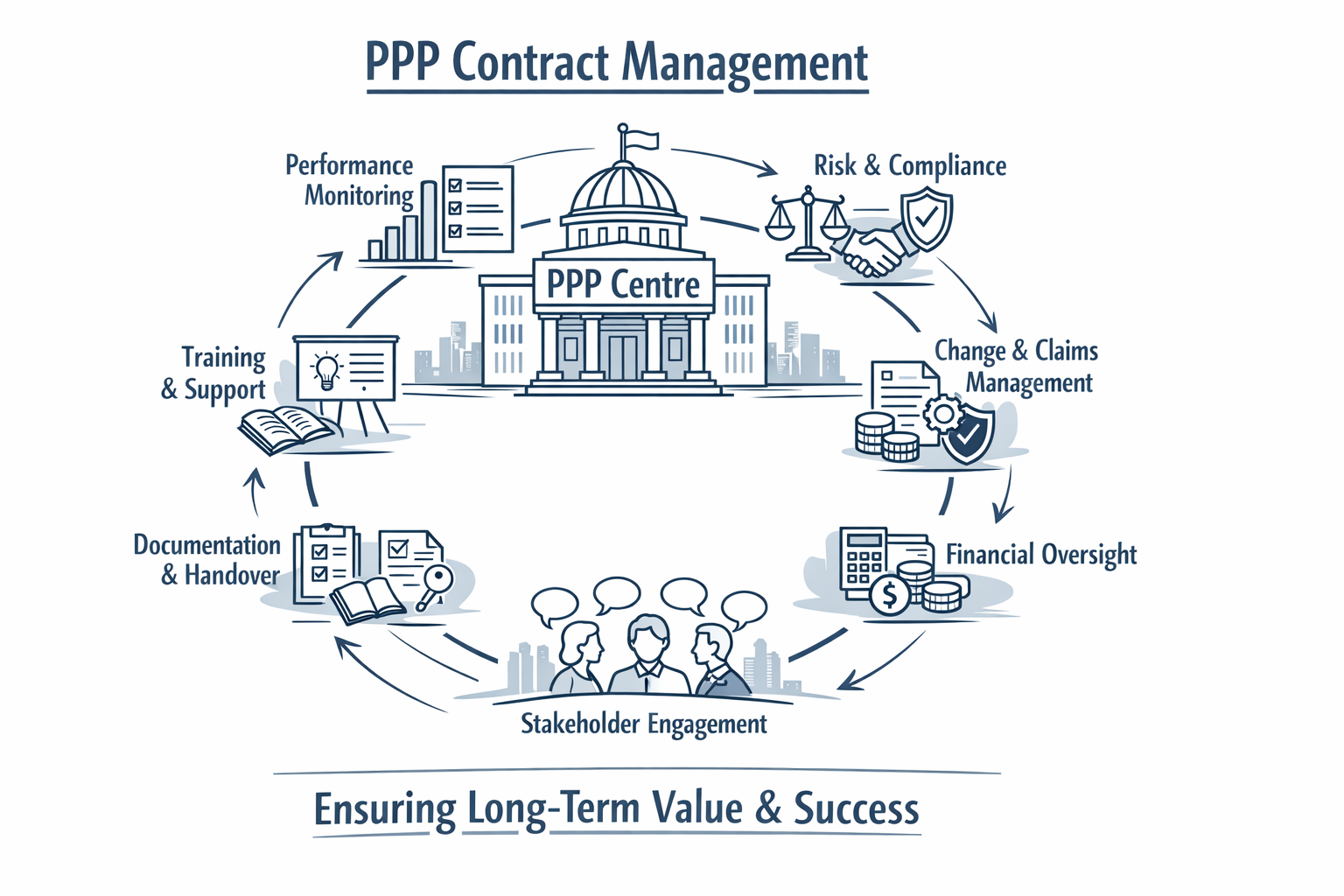
Once the project enters construction and operations, the contract management function focuses on performance monitoring. This includes reviewing technical and service reports, validating key performance indicators, conducting inspections, and maintaining a clear record of compliance and non-compliance. The emphasis is on early detection of issues—addressing problems while they are still manageable rather than allowing them to escalate.
Financial management is another central responsibility. Contract managers verify payment calculations, ensure deductions are correctly applied, and monitor the long-term affordability of the project. In availability-based PPPs, this discipline is critical to preventing “rubber-stamping” of payments that no longer reflect actual service quality.
Change and claims management form a significant part of day-to-day work. Contract managers assess variation requests, evaluate claims for compensation or time relief, and support negotiations with the private partner. This requires a careful balance: maintaining a collaborative relationship while rigorously defending the public interest.
Stakeholder management is often underestimated but no less important. PPP projects involve regulators, lenders, users, communities, and multiple government entities. Contract managers act as the focal point for coordination, ensuring that concerns are addressed transparently and that communication remains structured and consistent.
Finally, effective contract management looks ahead to the end of the concession. Planning for handback or expiry begins years in advance, with asset condition monitoring, documentation transfer, and operational transition planning. Governments that neglect this phase risk inheriting assets that are technically compliant but operationally unfit.
How Leading Countries Organize PPP Contract Management
International experience provides compelling examples of how these functions are institutionalized.
In the Philippines, the PPP Center acts as a national center of expertise, supporting line agencies with legal, financial, and technical capacity throughout implementation. Its involvement ensures continuity from project development through operations, reducing the risk of capability gaps after financial close.
The United Kingdom has long emphasized whole-life value for money through centralized oversight. National guidance promotes structured contract management arrangements, supported by central expertise housed in the Infrastructure and Projects Authority. This model has influenced similar approaches across Europe.
South Africa’s National Treasury assigns specialized PPP advisors to major projects, embedding expertise directly within contracting authorities while maintaining central oversight of fiscal risk. This hybrid model has proven effective in managing complex, long-term concessions.
In Colombia, the National Infrastructure Agency manages highway PPPs end-to-end, with dedicated project teams supported by a strong central legal and financial function. This institutional continuity has been a key factor in Colombia’s ability to manage a large PPP portfolio.
Even smaller or emerging economies, such as Tanzania and Papua New Guinea, have recognized the importance of contract management by investing in PPP Centres that focus explicitly on post-award monitoring and capacity building.
Conclusion: From Transaction Success to Long-Term Performance
PPPs succeed or fail not at signature, but over time. The difference between a well-performing partnership and a problematic one is rarely the contract itself - it is the capacity of the public sector to manage that contract intelligently and consistently.
Establishing a dedicated PPP Contract Management Function, ideally anchored in a central PPP Centre, is no longer a best practice reserved for advanced markets. It is a foundational requirement for any country seeking to protect public value, manage fiscal risk, and deliver reliable infrastructure and services through PPPs.
For governments serious about strengthening their PPP frameworks, the message is clear: transaction excellence must be matched by operational discipline. Contract management is not the end of the PPP lifecycle - it is where the real work begins.
The PPP Alliance is an independent body of knowledge for the advancement of Public-Private Partnership knowledge and best practices.
Interested in joining the community? Become a member today.
Stay connected with news and updates!
Join our mailing list to receive the latest news and updates from our team.
Don't worry, your information will not be shared.
We hate SPAM. We will never sell your information, for any reason.