
Output Specifications vs Input Specifications in PPPs
Feb 03, 2026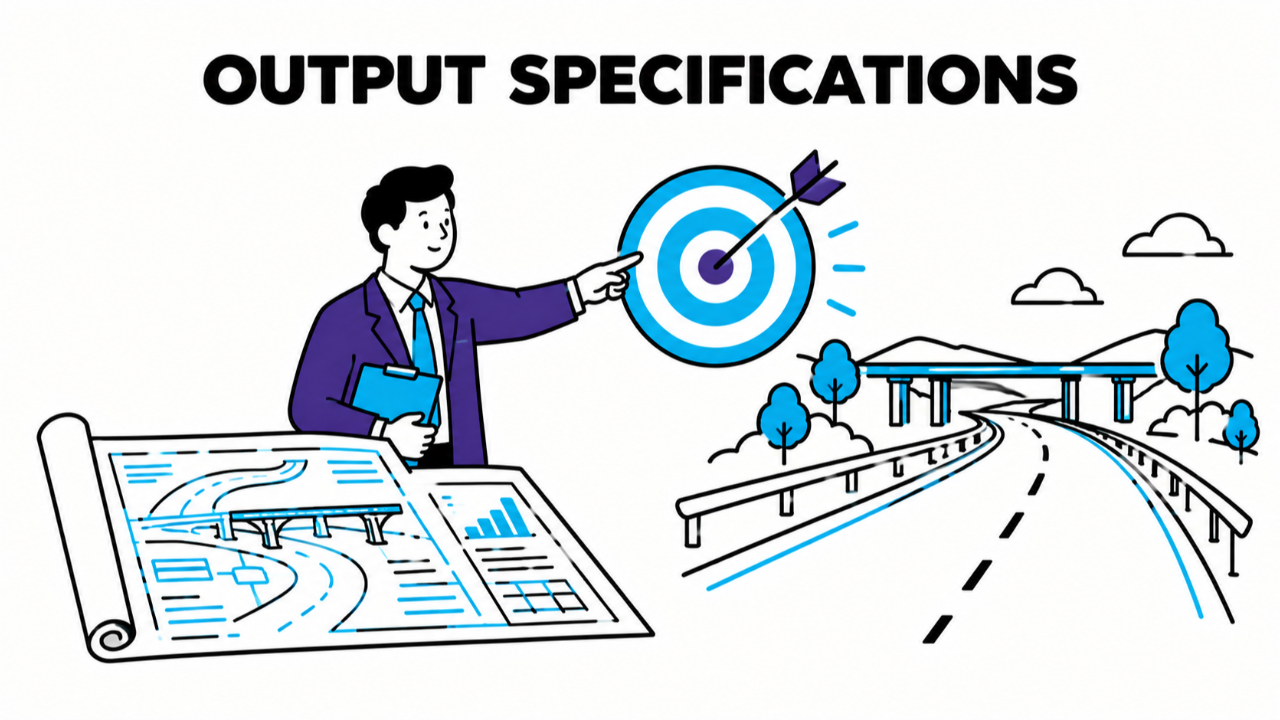
Output Specifications vs Input Specifications in PPPs
Output specifications describe what a PPP must deliver, not how to deliver it. Instead of telling the private partner which materials to use or how thick a road surface must be, an output specification sets the results required, such as a road that is available, safe and maintained to a defined ride quality. Output specifications are a defining feature of PPP contracts, and writing them well is one of the most important, and most difficult, tasks in preparing a PPP.
This article explains the difference between output and input specifications, why PPPs rely on outputs, and how to write effective output specifications.
Input vs output specifications
Input specifications describe the means: the design, materials, methods, staffing or equipment the contractor must use. They are typical of traditional procurement, where government designs the asset and the contractor builds what it is told.
Output specifications describe the ends: the performance, service levels and results the asset or service must achieve. The private partner decides how to achieve them.
| Input specification | Output specification | |
|---|---|---|
| Focus | How the work is done | What must be achieved |
| Example (road) | "Asphalt surface course of 50 mm thickness" | "Road surface roughness below a defined IRI value at all times" |
| Example (hospital) | "Install two 500 kW chillers" | "Maintain operating theatre temperature between 18°C and 22°C" |
| Example (school) | "Clean classrooms daily between 6 and 8 pm" | "Classrooms clean and ready for use by 8 am each school day" |
| Who designs the solution | Government | Private partner |
| Who carries design risk | Government | Private partner |
| Room for innovation | Limited | Significant |
Why PPPs use output specifications
They align with performance-based payment
In a PPP, the private partner is paid according to the asset's performance. That only works if performance is defined in terms of results that can be measured. The 2026 APMG PPP Certification Guide notes that, consistent with the performance focus of remuneration, technical and service requirements in a PPP are focused on output specifications rather than input specifications.
They transfer design and life-cycle risk
If government prescribes the design, it carries the risk that the design is wrong. With output specifications, the private partner chooses the design and bears the consequences if it fails to meet the required outputs. This supports genuine risk transfer.
They encourage innovation
The Guide stresses that interests should be aligned without being too prescriptive about means and methods, leaving reasonable scope for innovation. Bidders compete on how best to meet the outputs, which can bring new technologies, more efficient designs and better whole-life solutions. This is explored in innovation in PPPs.
They support the life-cycle approach
Because the private partner chooses how to meet outputs over the long term, it can optimise the trade-off between construction quality and maintenance cost, the core of the life-cycle approach.
What good output specifications look like
Good output specifications are often tested against the SMART criteria:
- Specific: clear about what is required, with no room for conflicting interpretations.
- Measurable: performance can be objectively monitored and verified.
- Achievable: realistic for a competent operator at a reasonable cost.
- Relevant: linked to what users and government actually need.
- Time-bound: with clear response and rectification times.
A useful structure for each requirement is: the output required, the performance standard, how it will be measured, how quickly failures must be fixed, and the payment consequence of failure.
Common mistakes
Inputs in disguise. Requirements that look like outputs but effectively prescribe a solution, such as specifying a particular brand or method, undermine risk transfer and innovation.
Unmeasurable outputs. "A high-quality, modern facility" sounds like an output but cannot be monitored or enforced. Every output needs a measurement method.
Too many indicators. Hundreds of KPIs create a monitoring burden for both parties and dilute focus. Concentrate on the outputs that matter most to users.
Ignoring the operating phase. Construction requirements are often well specified, while operating and maintenance requirements for a 25-year period are vague.
Mixing inputs and outputs inconsistently. If government specifies some elements in detail, it may take back the risk for related performance failures.
When input specifications are still needed
Pure output specification is an ideal. In practice, some input requirements are justified:
- Legal and safety standards, such as building codes and fire regulations.
- Interfaces with existing networks or systems that require specific technical standards.
- Policy requirements, such as accessibility, heritage or environmental constraints.
- Minimum design standards where long-term outputs are hard to measure.
The aim is to keep inputs to the minimum necessary and to be clear about who bears the risk for them.
From specifications to KPIs and payment
Output specifications become enforceable through the payment mechanism. Each key output is linked to KPIs, monitoring arrangements and deductions for failure. Well-written specifications therefore underpin everything from the tender evaluation to monitoring PPP performance with KPIs during operations.
This article is part of our PPP Fundamentals: The Complete Guide to Public-Private Partnerships.
Key takeaways
- Input specifications say how to do the work; output specifications say what must be achieved.
- PPPs rely on output specifications to link payment to performance, transfer risk and encourage innovation.
- Good output specifications are SMART and linked to measurement methods and payment consequences.
- Common mistakes include disguised inputs, unmeasurable outputs and too many indicators.
- Some input requirements remain necessary for safety, interfaces and policy, but should be kept to a minimum.
Go further
Want a structured grounding in these concepts? The CP3P Foundation course covers PPP definitions, models, the PPP process cycle and the essentials of project finance, aligned with the 2026 PPP Guide, and prepares you for the internationally recognised CP3P Foundation exam.
Related reading
- PPP Fundamentals: The Complete Guide to Public-Private Partnerships
- What Is a Public-Private Partnership (PPP)? A Complete Guide
- PPP Definitions Compared: World Bank, OECD, EU and IMF
- The Essential Features of a PPP Contract
- What Is a Private Finance PPP?
- Innovation in PPPs: How Output Specifications Unlock It
- Monitoring PPP Performance with KPIs
The PPP Alliance is an independent body of knowledge for the advancement of Public-Private Partnership knowledge and best practices. Interested in joining the community? Become a member today.
The PPP Alliance is an independent body of knowledge for the advancement of Public-Private Partnership knowledge and best practices.
Interested in joining the community? Become a member today.
Stay connected with news and updates!
Join our mailing list to receive the latest news and updates from our team.
Don't worry, your information will not be shared.
We hate SPAM. We will never sell your information, for any reason.