
A Short History of Public-Private Partnerships
May 14, 2026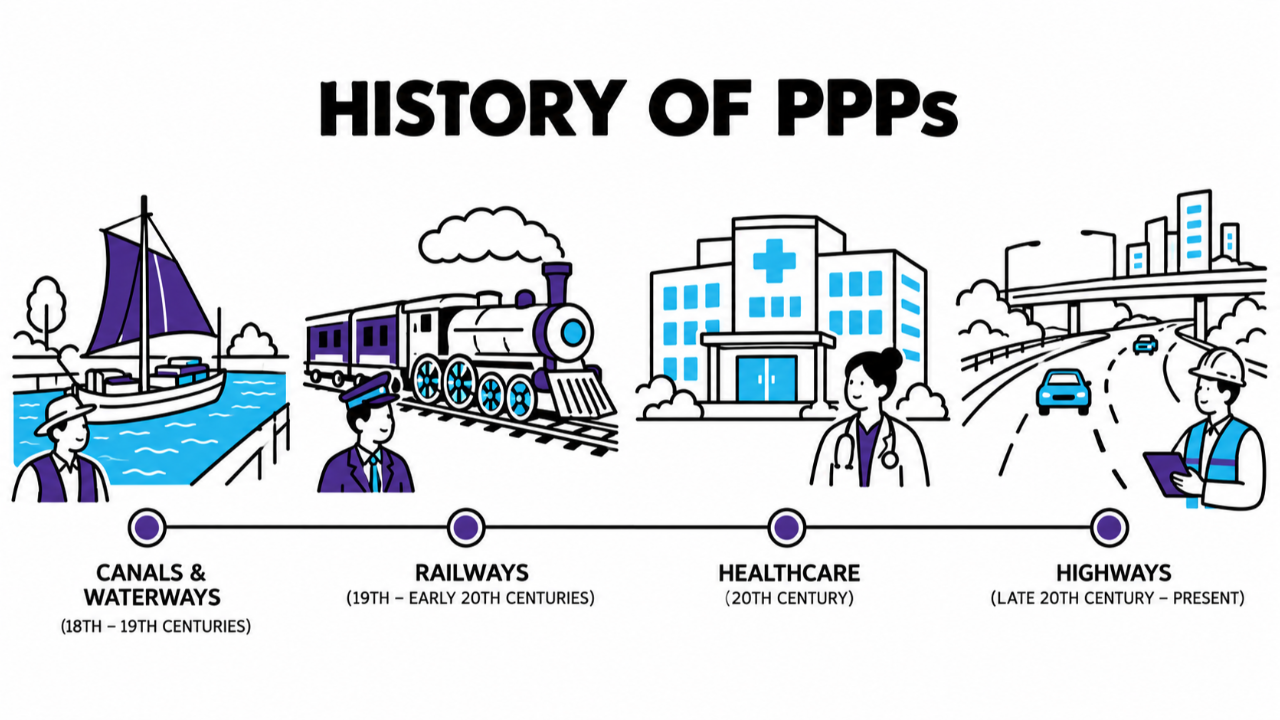
A Short History of Public-Private Partnerships
The history of PPPs is much older than the acronym. Governments have used private capital and private operators to deliver public works for centuries, from canal and road concessions in early modern Europe to the railways and water systems of the nineteenth century. The modern PPP model, with its focus on long-term risk transfer, output specifications and value for money, took shape in the 1990s and has since spread worldwide.
This article traces the main stages in the history of public-private partnerships and the lessons each one left behind.
Early roots: concessions and tolls
The idea of granting a private party the right to build or run a public asset in return for revenue is ancient. In ancient Rome, private contractors known as publicani undertook public works and collected taxes on behalf of the state.
In seventeenth-century France, the Canal du Midi, linking the Atlantic to the Mediterranean, was built between 1666 and 1681 under an arrangement in which its promoter, Pierre-Paul Riquet, invested his own fortune and was granted rights over the canal and its tolls. In England, from the late seventeenth century onwards, turnpike trusts borrowed against future tolls to improve and maintain roads.
These early arrangements contain the core of the user-pays concession: private money builds or improves an asset, and users repay it over time.
The nineteenth century: railways, canals and water
The industrial era greatly expanded private infrastructure. Much of the early railway network in Britain and the United States was privately financed and built. In France, the Compagnie Générale des Eaux was founded in 1853 to supply water to Lyon under a concession, establishing a tradition of private water concessions and leases (affermage) that France would later export.
The Suez Canal, opened in 1869, was built by a company holding a 99-year concession granted by the Egyptian government. It remains one of the best-known examples of a large concession, and of the political tensions that long-term contracts can create.
The twentieth century: state provision, then a return of private capital
For much of the twentieth century, governments in many countries built and ran infrastructure directly, often through state-owned enterprises. Private participation never disappeared, however. France and Spain, for example, used toll motorway concessions to build out their motorway networks from the 1950s and 1960s.
The 1980s and 1990s brought a wave of privatisation, as governments sold state-owned utilities and operators. Alongside this, they increasingly used concessions and project finance to deliver new assets. The privately financed Channel Tunnel, governed by a concession signed in 1986 and opened in 1994, became a landmark of large-scale project finance and of the risks involved in demand forecasting.
The 1990s: the birth of the modern PPP
The modern PPP model is most closely associated with the United Kingdom's Private Finance Initiative (PFI), launched in 1992. PFI applied private finance to social infrastructure that had no user revenue, such as hospitals, schools and prisons, with government paying the private partner through performance-based availability payments. It introduced many features now standard in PPPs: output specifications, payment deductions for poor performance, and value for money tests against a public sector comparator.
Other countries developed their own programmes. Chile launched a major road concession programme in the early 1990s that became a reference model for Latin America. Australia's state of Victoria introduced its Partnerships Victoria policy in 2000, and many countries in Europe, Asia and Africa set up PPP laws and dedicated PPP units in the following years.
The 2000s and 2010s: globalisation and lessons learned
PPPs spread rapidly, supported by multilateral development banks and international guidance. They were used across transport, energy, water, health and education, in both advanced and emerging economies.
Experience also exposed weaknesses. Some projects suffered from optimistic demand forecasts, poor preparation, frequent renegotiations or inflexible contracts. In the UK, criticism of PFI's cost and rigidity led to a reformed model, PF2, in 2012, and in 2018 the government announced it would no longer use PFI or PF2 for new projects. The lessons from the UK PFI experience continue to shape PPP policy worldwide.
At the same time, the profession matured. The World Bank and other institutions published the PPP Reference Guide, and multilateral development banks developed the APMG PPP Certification Programme, with its CP3P credential, to set a global standard for PPP practitioners.
Today: sustainable, resilient and well-governed PPPs
Recent years have added new priorities. The COVID-19 pandemic and geopolitical shocks tested the resilience of long-term contracts. Climate change, gender equality and social inclusion now feature prominently in PPP design. The 2026 edition of the PPP Guide reflects these shifts, with updated treatment of climate, gender, fiscal risk and contract management.
The direction of travel is clear: from PPPs as a way to access private finance towards PPPs as one carefully chosen tool among many, used only when they deliver value for money and public benefit.
Lessons from the history of PPPs
- Long-term contracts need flexibility. Assets outlive governments and technologies; contracts must manage change without losing their discipline.
- Demand risk is hard to price. From canals to tunnels, optimistic traffic forecasts have repeatedly undermined user-pays projects.
- Private finance is not free money. Users or taxpayers ultimately pay, and long-term commitments must be managed.
- Institutions matter. Countries with strong frameworks, PPP units and contract management capacity get better results.
- Public trust is essential. PPPs that look like privatisation by another name provoke resistance; transparency builds support.
This article is part of our PPP Fundamentals: The Complete Guide to Public-Private Partnerships.
Key takeaways
- Private concessions for public works date back centuries, from Roman contractors to French canals and English turnpikes.
- Nineteenth-century railways, water concessions and the Suez Canal set early precedents.
- The modern PPP took shape with the UK's PFI in 1992 and spread worldwide.
- Experience has led to reforms, more emphasis on value for money and stronger institutions.
- Today's PPPs increasingly focus on sustainability, resilience and good governance.
Go further
Want a structured grounding in these concepts? The CP3P Foundation course covers PPP definitions, models, the PPP process cycle and the essentials of project finance, aligned with the 2026 PPP Guide, and prepares you for the internationally recognised CP3P Foundation exam.
Related reading
- PPP Fundamentals: The Complete Guide to Public-Private Partnerships
- What Is a Private Finance PPP?
- What Is a Public-Private Partnership (PPP)? A Complete Guide
- The Spectrum of Private Participation in Public Infrastructure
- Infrastructure vs Public Services: What Can a PPP Deliver?
- PPP Policy Lessons From the UK PFI Experience
- The Benefits of Public-Private Partnerships
The PPP Alliance is an independent body of knowledge for the advancement of Public-Private Partnership knowledge and best practices. Interested in joining the community? Become a member today.
The PPP Alliance is an independent body of knowledge for the advancement of Public-Private Partnership knowledge and best practices.
Interested in joining the community? Become a member today.
Stay connected with news and updates!
Join our mailing list to receive the latest news and updates from our team.
Don't worry, your information will not be shared.
We hate SPAM. We will never sell your information, for any reason.