
Funding vs Financing in PPPs: A Critical Distinction
Jul 15, 2026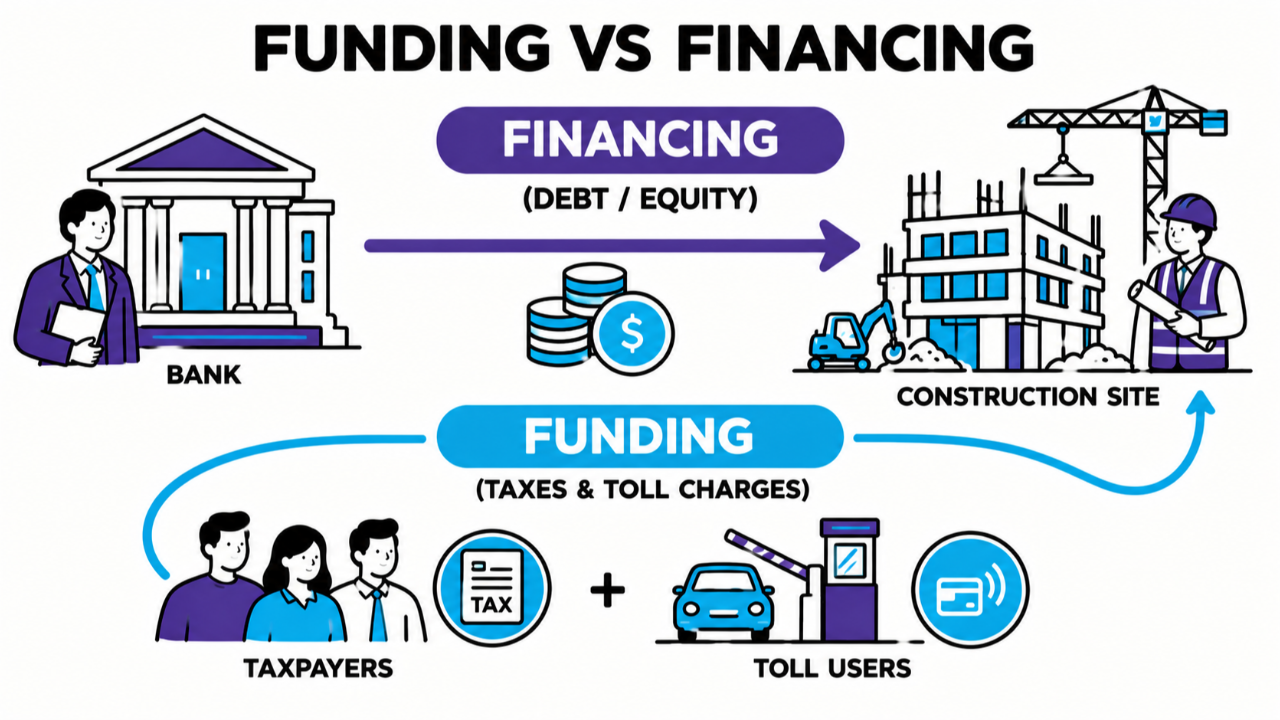
Funding vs Financing in PPPs: A Critical Distinction
Funding and financing are often used interchangeably, but in PPPs they mean very different things. Financing is the money needed upfront to build an asset. Funding is the money that ultimately pays for it over time. A PPP can bring in private financing, but the funding still comes from users or taxpayers. Confusing the two is one of the most common, and most costly, mistakes in PPP policy.
This article explains the difference between funding and financing in PPPs, why it matters, and how it shapes decisions about whether to use a PPP.
The definitions
The 2026 APMG PPP Certification Guide draws a clear line:
- Financing is the source of money required upfront to meet the costs of constructing infrastructure. In traditional procurement it usually comes from government surpluses or borrowing. In a PPP it comes from the private sector raising debt and equity.
- Funding is the source of money required to meet payment obligations over the long term, that is, to pay the private partner for its investment, operating costs and maintenance costs. Funding typically comes from taxes (in government-pays PPPs) or user charges (in user-pays PPPs).
Put simply, financing answers "who pays now?", and funding answers "who pays in the end?".
An illustration
Imagine a government needs a new hospital costing 200 million.
- Traditional procurement. Government finances the construction from its budget or by borrowing, and funds it, including repaying any borrowing, through taxes.
- Government-pays PPP. A private partner finances construction with equity and loans. Government then pays it an availability payment for 25 years, funded from taxes. The private partner uses those payments to cover operating costs, repay its loans and pay its investors.
In both cases, taxpayers fund the hospital. The PPP changes the timing of payments, who bears the risk and who manages the asset, not who ultimately pays.
Why the distinction matters
PPPs are not free money
Because a PPP brings in private financing, it can look as if the private sector is paying for public infrastructure. It is not. Private investors and lenders expect to be repaid with a return, from users or from government. A project that cannot be funded cannot be financed, however it is procured.
Fiscal commitments remain
A government-pays PPP may not appear as public debt in national accounts, depending on accounting rules. But the Guide is clear that it still creates a long-term commitment of public payments, explicit or contingent, that affects the government's fiscal position. Many countries cap their total PPP commitments for this reason. The article on whether PPPs create hidden public debt explores this in detail.
Private financing usually costs more
Private finance typically costs more than government borrowing. A PPP is only worthwhile if the efficiency gains from bundling, risk transfer and performance-based pay outweigh this extra cost. That is a value for money question, not a financing one.
Funding determines the PPP model
The funding source largely decides the type of PPP:
| Funding source | PPP type | Example |
|---|---|---|
| User charges cover all costs | User-pays PPP (concession) | Toll road with strong traffic |
| User charges cover part of the costs | Hybrid PPP with public support | Toll road with viability gap funding |
| Government budget | Government-pays PPP (availability) | Hospital, school, availability-based road |
If users cannot or should not pay enough, government must fund the gap, and the project's affordability must be tested.
Other sources of funding
Beyond taxes and user charges, governments can use more specific funding sources. The Guide highlights land value capture. New infrastructure, especially transport, often raises the value of nearby property. Land value capture mechanisms, such as land value taxes, betterment levies and development impact fees, or public real estate development on land near a new line, aim to recover part of that increase to help pay for the infrastructure. Transit-oriented development projects, such as the Hyderabad Metro Rail in India, have used this approach.
Earmarked taxes, such as fuel levies dedicated to roads, are another example.
Where financing comes from in a PPP
In a private finance PPP, the project company typically raises:
- equity from sponsors and investors;
- senior debt from banks, bond markets or development finance institutions;
- sometimes mezzanine debt or public co-financing.
The structure, sources and instruments are covered in how PPPs are financed and PPPs as a financing mechanism.
Questions every government should ask
- Who will fund this project over its life: users, taxpayers or both?
- Can users afford the charges, and is charging them acceptable?
- Can the budget afford the long-term payments, alongside all other PPP commitments?
- Does private financing add value, through efficiency and risk transfer, that justifies its higher cost?
If the answer to the first three is unclear, the project is not ready for a PPP.
This article is part of our PPP Fundamentals: The Complete Guide to Public-Private Partnerships.
Key takeaways
- Financing is the upfront money to build an asset; funding is the long-term source of money to pay for it.
- PPPs can bring private financing, but funding still comes from users or taxpayers.
- A PPP that is not recorded as public debt still creates long-term fiscal commitments.
- The funding source shapes the PPP model: user-pays, government-pays or hybrid.
- Land value capture and earmarked taxes can supplement funding for some projects.
Go further
Want a structured grounding in these concepts? The CP3P Foundation course covers PPP definitions, models, the PPP process cycle and the essentials of project finance, aligned with the 2026 PPP Guide, and prepares you for the internationally recognised CP3P Foundation exam.
Related reading
- PPP Fundamentals: The Complete Guide to Public-Private Partnerships
- What Is a Public-Private Partnership (PPP)? A Complete Guide
- PPP Definitions Compared: World Bank, OECD, EU and IMF
- The Essential Features of a PPP Contract
- What Is a Private Finance PPP?
- Co-Financing: Mixing Public and Private Funds
- PPPs as a Financing Mechanism: Promise and Limits
The PPP Alliance is an independent body of knowledge for the advancement of Public-Private Partnership knowledge and best practices. Interested in joining the community? Become a member today.
The PPP Alliance is an independent body of knowledge for the advancement of Public-Private Partnership knowledge and best practices.
Interested in joining the community? Become a member today.
Stay connected with news and updates!
Join our mailing list to receive the latest news and updates from our team.
Don't worry, your information will not be shared.
We hate SPAM. We will never sell your information, for any reason.