
Who Are the Parties in a PPP?
May 07, 2026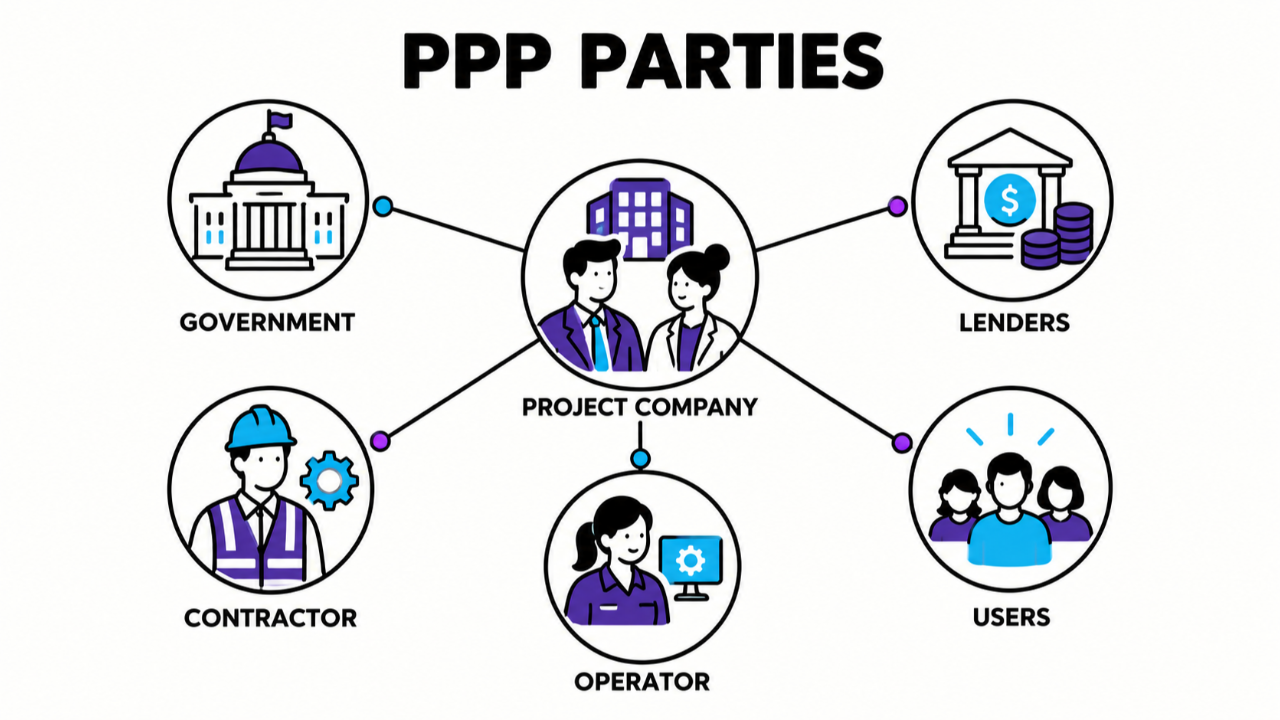
Who Are the Parties in a PPP?
A PPP brings together more parties than most public contracts. Beyond the government and the winning bidder, a typical private finance PPP involves a project company, its shareholders, lenders, construction and operating subcontractors, advisors and, of course, the users of the service. Understanding who does what, and how they are linked by contracts, is essential for anyone preparing, financing or managing a PPP.
This article introduces the parties in a PPP and their roles, based on the typical structure described in the 2026 APMG PPP Certification Guide.
The public side
The procuring authority
The procuring authority is the public body that identifies the project, prepares it, runs the tender, signs the PPP contract and manages it for its whole life. It may be a national ministry, a regional or municipal government, or an agency or public company acting on government's behalf. It is the "public partner" in the partnership.
Other government bodies
Several other public bodies are usually involved:
- The Ministry of Finance typically approves PPPs, assesses affordability and fiscal risk, and authorises long-term payment commitments.
- The PPP unit, where one exists, provides expertise, guidance and quality control, and may act as a gatekeeper in the approval process.
- Sector regulators may set tariffs, service standards or licences, especially in energy, water and transport.
- Other agencies handle permits, land acquisition, environmental approvals and utilities relocation.
The private side
The private partner and the project company (SPV)
The private partner is the contractual counterparty to the procuring authority. In most private finance PPPs, the winning consortium creates a new company, a special purpose vehicle (SPV), to sign the contract and deliver the project. The SPV:
- raises equity and debt;
- signs the PPP contract with the procuring authority;
- subcontracts construction and operations;
- receives the revenues and pays lenders and shareholders.
Ring-fencing the project in its own company protects lenders and sponsors, because the SPV's assets, liabilities and cash flows are separate from those of its owners.
Sponsors and equity investors
The sponsors are the companies that develop the bid and invest equity in the SPV. They are often construction firms, facility or infrastructure operators, or financial investors such as infrastructure funds. Equity investors are the first to absorb losses and the last to be paid, which gives them a strong interest in the project's success.
Lenders
Lenders provide most of the money, usually 70% to 90% of the project cost in a typical project finance structure. They may be commercial banks, bond investors, development finance institutions or export credit agencies. Because they are repaid only from the project's cash flows, lenders scrutinise the contract, the technical solution and the financial model closely. They usually sign a direct agreement with the procuring authority that gives them rights to step in and fix a failing project before the contract is terminated.
Construction (EPC) contractor
The SPV subcontracts design and construction to an EPC contractor, often a sponsor or an affiliate. The construction contract passes construction risk "back-to-back" from the SPV to the contractor, so that the contractor bears the cost of delays and defects.
Operations and maintenance (O&M) contractor
Similarly, the SPV subcontracts operation and maintenance to an O&M contractor, which takes on the performance obligations and deduction risk for the operating period.
Other key participants
- Users. The public who use the asset or service. In user-pays PPPs they pay tolls or tariffs directly to the private partner.
- Independent engineer or certifier. Monitors and certifies construction progress and completion, often on behalf of both the authority and the lenders.
- Advisors. Both sides rely on legal, financial and technical advisors. The procuring authority's transaction advisors help prepare and tender the project; lenders appoint their own technical, insurance and legal advisors.
- Insurers. Cover construction, operational and liability risks.
- Offtakers. In energy and water PPPs, a utility that buys the output under an offtake agreement, such as a Power Purchase Agreement.
- Communities and civil society. People affected by the project, whose support is essential for its long-term success.
How the parties fit together
| Party | Main contract | Main interest |
|---|---|---|
| Procuring authority | PPP contract with SPV | Reliable, good-quality service and value for money |
| SPV | PPP contract, financing agreements, subcontracts | Delivering the contract profitably |
| Sponsors / equity investors | Shareholders' agreement | Return on equity |
| Lenders | Loan agreements, direct agreement | Repayment of debt with interest |
| EPC contractor | Construction contract | Construction margin |
| O&M contractor | O&M contract | Operating margin |
| Users | (Indirect) | Affordable, reliable service |
The overall arrangement is explained in more detail in the article on PPP project structure.
Why understanding the parties matters
Risk flows through the structure. Risks transferred to the SPV are largely passed on to subcontractors and, ultimately, absorbed by equity and then debt. A procuring authority that understands this chain can design a contract the market will accept.
Interests differ. Sponsors who are also contractors may focus on construction margins; lenders on stable cash flows; government on long-term service. Good contract design aligns these interests.
Relationships last decades. Most of these parties will be working together for 20 years or more. Clear roles and governance prevent disputes.
This article is part of our PPP Fundamentals: The Complete Guide to Public-Private Partnerships.
Key takeaways
- The procuring authority is the public partner; the Ministry of Finance, PPP unit and regulators also play key roles.
- The private partner is usually an SPV owned by sponsors and financed mainly by lenders.
- The SPV subcontracts construction and operations, passing risks down "back-to-back".
- Lenders, independent engineers, advisors, insurers and users all shape how a PPP performs.
- Understanding each party's interests is essential for structuring and managing a PPP.
Go further
Want a structured grounding in these concepts? The CP3P Foundation course covers PPP definitions, models, the PPP process cycle and the essentials of project finance, aligned with the 2026 PPP Guide, and prepares you for the internationally recognised CP3P Foundation exam.
Related reading
- PPP Fundamentals: The Complete Guide to Public-Private Partnerships
- What Is a Procuring Authority in a PPP?
- What Is a Private Finance PPP?
- What Is a Public-Private Partnership (PPP)? A Complete Guide
- The Spectrum of Private Participation in Public Infrastructure
- What Is a Special Purpose Vehicle (SPV) in a PPP?
- The Basic Structure of a PPP Project
The PPP Alliance is an independent body of knowledge for the advancement of Public-Private Partnership knowledge and best practices. Interested in joining the community? Become a member today.
The PPP Alliance is an independent body of knowledge for the advancement of Public-Private Partnership knowledge and best practices.
Interested in joining the community? Become a member today.
Stay connected with news and updates!
Join our mailing list to receive the latest news and updates from our team.
Don't worry, your information will not be shared.
We hate SPAM. We will never sell your information, for any reason.